
If you are asking yourself, “how can I prepare for JEE Mains when I cannot join a coaching institutes?”, you are not alone. Every year, a large number of aspirants study from home, whether because of budget, distance, school schedule or simply a preference for learning at their own pace. The good news is that JEE Main rewards clear concepts, steady practice and honest self-analysis. None of these can be bought; they have to be built, and you can build them at home.
This guide is written for JEE 2027 preparation. It explains how to prepare for JEE Mains at home, which free resources to use, how to divide your remaining weeks, what to study in Physics, Chemistry and Mathematics, and how to use mock tests so that each one actually improves your score. Read it once fully, then pick the plan that fits the time you have left.
JEE Main 2027 at a Glance
Before planning anything, know what you are preparing for. The table below summarises the exam as it stands right now.
| Detail | Information |
| Conducting body | National Testing Agency (NTA) |
| Session 1 (tentative) | 22 to 24 January and 28 to 30 January 2027, with 31 January kept as a buffer day |
| Session 2 | Expected in April 2027; exact dates are yet to be notified. |
| Mode | Computer-based test (CBT) |
| Duration (B.E./B.Tech paper) | 3 hours |
| Subjects | Physics, Chemistry, Mathematics |
| Structure per subject | 20 multiple-choice questions plus 5 numerical-value questions |
| Total questions and marks | 75 questions, 300 marks |
| Marking | +4 for a correct answer, negative marking for wrong answers, nothing for unattempted questions |
Important: The January dates come from NTA’s examination calendar, which the agency itself describes as tentative. The detailed information bulletin, which carries the registration schedule and the final pattern, is still to come. Bookmark jeemain.nta.nic.in and re-check the pattern when the bulletin is released.
With Session 1 scheduled for late January, you have roughly 15 weeks from today. That is enough time to make a real difference if you plan it properly, and Session 2 in April gives you a second attempt to improve.
Can You Really Prepare for JEE Mains Without Coaching?
Yes, but be honest about what coaching actually provides. A good institute gives you four things: a fixed schedule, curated material, regular tests and someone to ask when you are stuck. When you study alone, you must supply those four things yourself. Nothing else separates the two routes.
Self-study works well for students who can do the following consistently:
- Follow a timetable without someone checking on them
- Solve problems independently before looking at solutions
- Take tests and analyse them without avoiding the painful mistakes
- Seek help on a specific doubt instead of letting it pile up
If you can do most of these, you can crack JEE Main by self-study. If one of them is weak, do not give up; fix that one gap. For example, if doubt-resolving is your weakness, join a free online doubt community or ask a school teacher once a week. Self-study does not mean studying in isolation.
Step 1: Understand the Syllabus and Exam Pattern
Most students skip this step and pay for it later. Download the official JEE Main syllabus from the NTA website and print it. Then convert it into a chapter checklist with four columns:
- Concept studied
- Practice questions solved
- Timed test attempted
- Revised at least twice
A chapter is finished only when all four boxes are ticked, not when you have read it once. So many chapters in the Class 11 and Class 10+2 syllabus feed into each other, so a checklist also shows you the order in which to study them. For instance, vectors and calculus support much of physics, so postponing them makes everything harder.
Step 2: Take a Diagnostic Test Before Making a Timetable
A timetable built on guesswork collapses within a week. Instead, begin with a short diagnostic: pick 10 to 15 questions per subject from chapters you have already studied and attempt them without notes. Then sort every chapter into one of four groups:
- Not started
- Concept is weak
- Understood but slow
- Ready for mixed practice
This sorting tells you where your hours should go. Students who skip it usually spend most of their time on the chapters they already enjoy, which feels productive but moves the score very little.
Step 3: Build a Plan Backwards from the Exam Date
Do not copy a twelve-month schedule if you have fewer months. Plan backwards from the date you are targeting, and keep revision and testing inside the plan from week one. The table below is a 15-week plan for Session 1 (January 2027). If you are aiming at Session 2 in April, stretch each phase proportionally.
| Weeks | Phase | What to do | Tests |
| 1 | Assessment | Diagnostic test, chapter checklist, choose resources | One diagnostic per subject |
| 2 to 6 | Concept completion | Finish unfinished and weak chapters; solve examples and chapter exercises; 20 minutes of daily recall | One chapter test per week |
| 7 to 10 | Practice and gap repair | Topic-wise previous year questions; combine chapters into mixed sets; start an error notebook | One full-length mock every 7 to 10 days |
| 11 to 13 | Exam simulation | Full syllabus revision; two full mocks weekly; detailed analysis of each | Two mocks a week |
| 14 to 15 | Final polish | Short notes, formula and reaction revision, only the previous mistakes; no new resource | Alternate-day mocks, light revision on the other days |
If you are a Class 12 student, let school topics anchor your week and set aside separate slots for Class 11 gaps. If you are a dropper, begin by identifying why last year did not work: unfinished syllabus, weak recall, calculation errors, or poor decisions during the paper. Repeating the same routine and expecting a different result is the most common trap.
How to Prepare for JEE Mains at Home: A Daily Timetable
Here is a sample day for a student who studies at home alongside school. The structure matters more than the exact timings, so shift the blocks to suit your day.
| Block | Duration | Task |
| Recall | 20 minutes | Write down yesterday’s formulas, reactions or methods from memory, then check your notes |
| Concept block | 60 minutes | Study one manageable topic and try its solved examples before reading the solutions |
| Practice block | 60 minutes | Solve a selected exercise and mark every question you were unsure about |
| Timed block | 45 minutes | Attempt a mixed set from topics already covered, under a time limit |
| Review block | 20 minutes | Log errors in your notebook, list doubts and fix tomorrow’s first task |
That adds up to roughly three and a half hours of focused work. Students with more free time, such as droppers, can run this cycle twice a day. Whatever you choose, set the target for each session as an output (“complete 25 questions on rotational motion and review mistakes”) rather than an input (“study Physics for two hours”). Outputs can be checked; hours cannot.
Two habits keep this routine alive. Start by rotating your subjects so that you do not consistently study the same subject during your least energetic hour.. Second, protect sleep and meals. Late-night studying feels heroic but quietly damages recall the next day.
JEE Main Preparation Online Free: Resources You Can Start Using Today
You do not need a paid course to start. These free options cover almost everything a self-study student needs:
- NCERT textbooks (Class 11 and 12): Available free on the official NCERT website. They are the base for all three subjects and especially for Chemistry.
- NTA Abhyas app and NTA mock tests: The National Testing Agency’s own free mock-test platform lets you experience the computer-based format before the real exam.
- Official previous year papers: The NTA website and several coaching portals publish past JEE Main papers at no cost. Use these for topic-wise practice.
- NPTEL and SWAYAM: Free courses and lectures delivered by IIT faculty. They are helpful for understanding difficult concepts that are hard to grasp, although they may take more time than a typical coaching lecture.
- YouTube lectures from established educators: Use them for specific chapters rather than binge-watching a whole playlist.
- Free mock tests from coaching institutes and education portals: Many publish a few full-length papers each season. Treat them as extra practice after the NTA mocks.
A word of caution about “free”: the real cost of online material is your attention. Pick one explanation source and one practice source per subject, then stay with them. Collecting ten playlists and five PDFs creates the feeling of preparation without the substance.
Subject-Wise Strategy for Self-Study
Physics: Connect the Concept to the Equation
Physics rewards students who understand why a formula works, not those who memorise a hundred of them. Before you calculate, draw the situation, list what is known and name the principle you will use. Then check whether its conditions hold. For example, mechanical energy is conserved only when no non-conservative force does work, and many students lose marks by applying the law blindly.
Once you have solved the problem, verify the units, signs, and whether the result makes physical sense. If you get stuck on a question, identify where the difficulty occurred—selecting the right model, setting up the equations, or handling the algebra. The solution will depend on the specific mistake.
Chapters that deserve extra time (based on recent paper trends compiled brday’s formulas, reactions or methods from memory, then check your notes by coaching analyses): Laws of Motion, Work Energy and Power, Rotational Motion, Electrostatics, Current Electricity, Magnetism and Electromagnetic Induction, Ray Optics, Modern Physics and Semiconductor Electronics.
Chemistry: Three Sections, Three Methods
Chemistry is often the most scoring subject, so do not treat it as an afterthought.
- Physical Chemistry: Note down the relevant formula, keep an eye on the units, and solve numerical problems independently without checking the answers first. Thermodynamics, equilibrium, chemical kinetics and solutions repay regular practice.
- Organic Chemistry: First understand electronic effects and why a reaction happens. Only then memorise transformations. Build a reaction map showing reagents, conditions and exceptions.
- Inorganic Chemistry: Use short recall sessions. Write what you remember from a blank page, then correct it using the textbook. Coordination compounds, d- and f-block elements and periodic trends are frequent sources of questions.
Read NCERT line by line, including the examples and in-text questions. A big share of Chemistry questions is built directly on it.
Mathematics: Practise Choosing the Method
Mathematics is usually the longest section and often decides rank. Work through problems on paper and show sufficient steps so you can identify and correct your mistakes later. Always verify the domain, restrictions, and any extraneous roots rather than accepting the first algebraic result you obtain.
Once you are confident with a chapter, combine it with previously learned chapters so that the heading does not give away which method to use. That is how the real paper behaves. High-priority areas: Calculus (limits, derivatives, integrals, differential equations), Coordinate Geometry (straight lines, circles and conics), Matrices and Determinants, Complex Numbers, Probability, Binomial Theorem, Vectors and 3D Geometry.
Choose Books You Can Actually Finish
Buying five books per subject creates unfinished work, not better understanding. For JEE Main, a lean set is enough:
- Physics: NCERT, then a clear concept book such as H. C. Verma, followed by exam-level practice
- Chemistry: NCERT first, then one graded practice book for numericals and application questions
- Mathematics: NCERT plus one JEE-oriented book with worked examples and progressively harder exercises
- Across all subjects: Previous year questions
When you watch a lecture, close it afterwards and resolve related questions yourself. If you cannot start without replaying the solution, the next task is active practice, not another lecture.
Previous Year Questions and Mock Tests: Where Scores Are Made
Previous year questions (PYQs) show you what the exam actually asks, how deep it goes and which concepts keep returning. A sensible order is:
- Topic-wise PYQs while you are still learning a chapter
- Mixed timed sets once several chapters are done
- Full-length papers in the final weeks
Use only questions that match the current syllabus. Older papers sometimes contain topics that have since been removed.
How to Analyse a Mock Test
A score is only a number. The learning is in the review. After every test:
- Check three groups: wrong answers, skipped questions and lucky guesses. A correct guess hides a gap just as well as a wrong answer reveals one.
- Name the cause: concept gap, forgotten fact, calculation slip, misreading, or poor time use.
- Assign a repair: relearn the idea, practise similar questions or change how you read and choose questions.
- Retest after a few days: solve the same question without the solution, then a new question on the same idea.
Suppose you keep losing marks through sign errors in electrostatics. The cure is drawing direction diagrams and fixing a sign convention, not rereading the whole chapter. Keep an error notebook with the question, your attempt and the exact step where your reasoning broke. It becomes your best revision material in the last fortnight.
Attempt Strategy: Accuracy Beats Attempting Everything
JEE Main has negative marking, so reckless guessing costs more than it gains. A reliable approach is to go through the paper in rounds. In round one, answer every question you can solve confidently. In round two, return to the medium ones. Leave the rest for the end, and skip any question for which you cannot see a method within about a minute. Practise this in mocks until it feels automatic.
Because Mathematics tends to be the longest section, do not let it swallow your time. Decide your section order and time limits during mocks, not on exam day.
Revision Methods That Work Without a Teacher
Revision is not rereading. It is retrieving information from memory and fixing what you could not recall.
- Spaced revision: Revisit a topic the next day, then after about a week, then after a few weeks. Adjust the gaps based on how much you can actually recall.
- Flashcards: Use them for formulas, named reactions, periodic trends and exceptions. Three short sessions a week are enough.
- Short notes: One page per chapter, written in your own words, with the traps you have fallen into before.
- Mixed problem sets: Combine old and new chapters so you retrieve methods instead of simply following the heading.
A practical four-step routine for each revision session: recall the key ideas without notes, check what you missed, solve a few representative questions including one you got wrong earlier, and schedule another review if recall is still weak.
Handling Doubts When You Study Alone
Keep a doubt notebook. For each doubt, write the question, your attempted steps and the point where your logic failed. A precise doubt (“why is momentum conserved for this chosen system?”) is much easier to resolve than a vague one (“I do not understand collisions”). Group doubts and clear them in one scheduled session each week, using a school teacher, a trustworthy study partner, a verified online educator or a standard textbook solution. Struggling alone for hours over a single doubt is rarely the sign of dedication it feels like.
Staying Healthy and Motivated
Fifteen weeks is a sprint inside a marathon, so protect the basics. Sleep for seven to eight hours, eat proper meals, step outside daily and keep a little time for something you enjoy. Reduce your phone use during study blocks, because a distracted hour is worth far less than a focused thirty minutes. Track progress with a simple weekly review: chapters completed, test accuracy and repeated errors. If you ever feel overwhelmed, shrink the task rather than abandoning it. Finishing a smaller target teaches your brain that the plan works.
Common Mistakes to Avoid
- Starting without a diagnostic: You end up studying what you already know
- Resource hopping: Switching books and channels every week
- Watching lectures without solving questions: Passive learning feels like progress
- Taking mocks but skipping analysis: The same mistakes return on exam day
- Ignoring NCERT: Especially costly in Chemistry
- Neglecting weak chapters: Avoiding them leaves easy marks on the table
- Learning big new topics in the last fortnight: Revision and error correction pay better
- Poor sleep before mocks and the exam: Fatigue creates calculation errors
What to Do in the Last 30 Days
If most of the syllabus is familiar, spend the final month on mixed practice, full-length mocks, short notes and the errors in your notebook. Alternate demanding test days with analysis and light revision days; a mock every single day is not compulsory. Keep recalling formulas and reactions rather than only reading them. Avoid starting a large new resource. Practise moving on from an unproductive question and returning to it later. Keep your sleep routine steady so that revision does not reduce concentration.
If large parts of the syllabus are still untouched, be realistic. Pick chapters that you can master with the foundation you already have, and aim for solid marks in those instead of surface-level coverage of everything. You also have Session 2 in April as a second opportunity.
Frequently Asked Questions
How can I prepare for JEE Mains in a short time?
Take a diagnostic test, list the chapters in order of importance and strength, and finish the high-priority chapters first. Practise mixed questions early, take regular mocks and keep one short revision block every day. Do not try to master every corner of the syllabus.
Can I crack JEE Main without coaching?
Yes, many students do. You need a syllabus checklist, limited but good resources, a doubt routine and honest test analysis. If a particular topic keeps blocking you, take targeted help for that topic instead of abandoning self-study.
How to prepare for JEE Mains by self-study if I am in Class 12?
Plan your week around your school syllabus, while setting aside additional study sessions for Class 11 chapters that you still need to strengthen. Because boards and JEE overlap in many chapters, studying them together saves time. Keep a weekly test and a weekly buffer session for unfinished work.
Is JEE Main preparation online free really possible?
Yes. NCERT books, NTA mock tests, official previous year papers, NPTEL and SWAYAM courses, and many free educator videos cover the essentials. The challenge is selecting a few and completing them.
How many hours should I study every day?
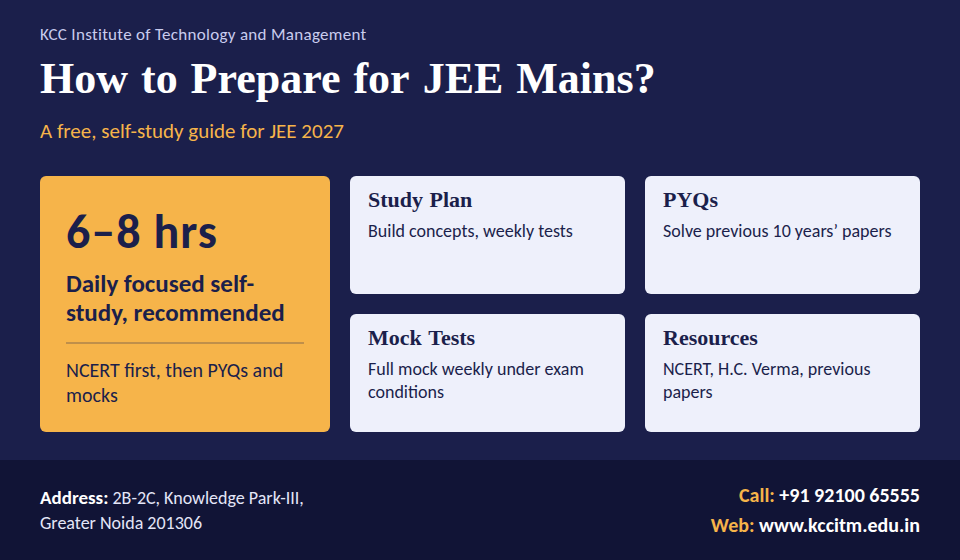
There is no magic number. A focused three to four hours outside school can be enough for a Class 12 student if it includes recall, problem solving and review. Droppers often study six to eight hours. Quality matters more than the clock, so judge yourself by what you can solve, not hours logged.
Is NCERT enough for JEE Main?
NCERT is essential, especially for Chemistry, but it works best alongside graded practice questions and previous year papers, particularly for Physics and Mathematics.
How many mock tests should I take before JEE Main?
Start with chapter and part-syllabus tests, then add full-length mocks as the syllabus becomes familiar. In the last four to five weeks, many students take two a week. Only increase the number if you can review each one properly.
When is JEE Main 2027 Session 1?
According to NTA’s tentative examination calendar, Session 1 is scheduled for 22 to 24 and 28 to 30 January 2027, with 31 January as a buffer date. Session 2 is expected in April 2027. Confirm everything on the official website, because the schedule can change.
Conclusion
So, how can you prepare for JEE Mains without coaching? Begin with the syllabus and a diagnostic, build a plan backwards from your exam date, use a small set of good free resources, and treat every mock test as a lesson rather than a verdict. JEE 2027 preparation does not require a perfect setup; it requires a plan you can follow on ordinary days. Start today with one chapter, one practice set and one honest review, and repeat it tomorrow.
Disclaimer: Exam dates and patterns mentioned here are based on NTA’s published calendar at the time of writing and may change. Always verify on jeemain.nta.nic.in.