

CLAT 2027 Eligibility Criteria: The Complete Guide
Before you worry about mock tests, study plans or which National Law University to target, there is a more basic question: are you allowed to take the exam? The CLAT 2027 eligibility criteria answer that, and the good news is that they are far less restrictive than those of most national entrance tests.
The Consortium of National Law Universities will hold the Common Law Admission Test on 6 December 2026 for both undergraduate (UG) and postgraduate (PG) aspirants. This guide walks through every rule that decides your eligibility: the qualification you need, the marks you must have, the age position, and the grey areas students keep asking about.
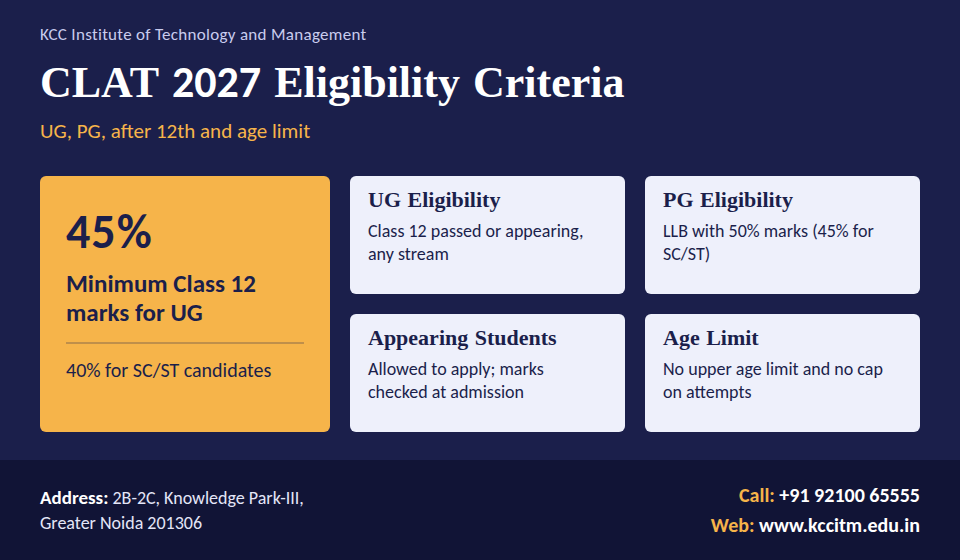
CLAT Eligibility Criteria in 60 Seconds
If you only have a minute, this table is the whole story.
| Question | UG (5-year law degree) | PG (LL.M.) |
|---|---|---|
| Who can apply? | Class 12 pass-outs, and students appearing in 2027 | LL.B. graduates, and final-year students appearing in 2027 |
| Minimum marks (General/OBC and similar) | 45% | 50% |
| Minimum marks (SC/ST/PwD) | 40% | 45% |
| Upper age limit | None | None |
| Proof of result | Needed at admission if you were still appearing | Needed at admission if you were still appearing |
Everything below explains the reasoning, the fine print and the exceptions behind those cells.
Key Dates That Frame Your Eligibility
Eligibility only helps if you act in time. These are the dates that matter right now.
| Milestone | Date |
|---|---|
| Notification released | 22 July 2026 |
| Application opened | 3 August 2026 |
| Application closes | 7 November 2026, 11:59 PM |
| Admit card (expected) | Third week of November 2026 |
| CLAT 2027 exam | Sunday, 6 December 2026, 2:00 PM to 4:00 PM |
In earlier years the Consortium sometimes pushed the closing date back by a week, but nothing of the sort had been announced for 2027 when this article was checked. Plan as though 31 October is final.
CLAT UG Eligibility Criteria 2027
The UG paper opens the door to integrated five-year programmes such as B.A. LL.B., B.Com. LL.B., B.B.A. LL.B. and B.Sc. LL.B. at the participating universities.
1. Qualifying examination
You must have cleared the senior secondary level, meaning Class 12 or a qualification regarded as its equivalent. The criteria do not require any specific subject combination, so students of any stream stand on the same footing.
2. Minimum aggregate marks
- 45% (or the equivalent grade) for General, OBC, EWS and similar applicants, including NRI, OCI and PIO candidates.
- 40% (or the equivalent grade) for candidates in the SC, ST and PwD groups.
Be careful with PwD. Some coaching and college websites place PwD students in the 45% group. The Consortium’s own UG criteria page treats PwD like SC and ST, at 40%, so rely on that.
3. Students who are yet to take Class 12
If your board examinations fall in March or April 2027, you may still register. The condition is that you must furnish evidence of having passed when admission is processed. Miss that, and the university can drop you from consideration regardless of your rank.
4. Age
No upper age ceiling exists for UG.
CLAT Eligibility After 12th: What Class 12 Students Should Know
Since the largest share of applicants are school-leavers, it helps to answer the “CLAT eligibility after 12th” question from a student’s point of view rather than just quoting rules.
Do I need a particular stream? No. Arts, Commerce, Science and other combinations are all accepted under the published criteria. Quantitative Techniques in the paper is limited to basic mathematics, so even students who dropped maths after Class 10 are not at a disadvantage in terms of eligibility.
Can I apply while my Class 12 exams are pending? Yes. Apply this year, write the board exams in the spring, and submit proof of passing when your admission is processed.
What if my marks are borderline? Check the cut-off carefully. A Class 12 aggregate of 44% will not satisfy a General-category requirement of 45%, however strong your CLAT score. Where your marksheet shows grades or CGPA, find out how your board converts them into percentages and ask the university how it treats that conversion.
I took a gap year or am repeating an attempt. Does it affect eligibility? The published criteria do not set a limit on gap years or on how many times you may appear in CLAT. Some universities may ask for an affidavit about a break in studies at the admission stage, so keep one ready if it applies to you.
I studied through an open school or a foreign board. Am I eligible? The word used is “equivalent”, and the university or the Consortium decides what counts. If your board is unusual, write to the CLAT help desk early and keep the reply in writing.
What happens after I qualify? CLAT ranks you, and then counselling places you into a university according to rank, category and seat availability. Eligibility alone does not guarantee a seat.
CLAT PG Eligibility Criteria 2027
The PG route is meant for law graduates who want a one-year LL.M. at the participating universities.
1. Qualifying degree
You need an LL.B. (three-year, or five-year integrated) or an equivalent degree. Because the universities check recognition during admission, make sure your law college is approved by the Bar Council of India.
2. Minimum aggregate marks
- 50% (or the equivalent grade) for General, OBC and similar applicants.
- 45% (or the equivalent grade) for SC, ST and PwD candidates.
These percentages are calculated on your law degree. A few aggregator pages carelessly mention Class 12 marks while describing PG rules, which causes unnecessary panic. Read the official PG page rather than relying on a summary.
3. Final-year students
Students appearing for their last LL.B. examinations in 2027 can apply. Like UG candidates in the same position, they must submit evidence of passing during admission or lose the claim to a seat.
4. Age
No upper age limit applies to PG either.
CLAT 2027 Eligibility Criteria for PG: A Quick Self-Check
Ask yourself four questions:
- Does my LL.B. (or equivalent) come from a Bar Council of India recognised institution?
- Is my aggregate at least 50%, or 45% if I belong to SC, ST or PwD?
- If my results are not out yet, will I have the degree certificate or result proof ready by admission time?
- Have I confirmed the PG programme and specialisation offered by the university I want?
If all four answers are yes, you meet the CLAT PG eligibility criteria 2027.
CLAT Eligibility Age: Is There Any Upper or Lower Limit?
This is probably the most searched part of the topic, so here it is plainly.
- Upper age limit for UG: none.
- Upper age limit for PG: none.
- Number of attempts: no restriction has been announced.
The practical meaning is that a school student, a working professional who wants to switch careers, and a graduate returning to study are all treated the same way, provided the qualification and marks conditions are met.
There is no separate minimum-age rule either. The lower bound is effectively set by the qualification: you need a Class 12 pass or a law degree, or you must be appearing for it in 2027.
Age does come into the picture in one narrow case: when UG candidates tie on score, the Consortium resolves it first by higher Legal Reasoning marks, then by giving preference to the older candidate, and lastly by a computerised draw. That affects ranking, not eligibility.
Special Cases That Cause Confusion
Improvement or supplementary exams
Passing a subject through a later attempt does not by itself make you ineligible. The thing to watch is paperwork: if you hold more than one marksheet, ask your university how it wants them presented, and clear this up before counselling.
NRI, NRI-sponsored, OCI and PIO applicants
They sit the same CLAT paper and then apply directly to the university of their choice with status certificates. The conditions for this quota differ across universities, so read each one’s rules.
Reservation and domicile
Reservation is not part of the basic CLAT eligibility, but it decides which seats you can claim. Each university has its own matrix. The Consortium recently revised the categories for WBNUJS Kolkata, NLU Meghalaya and MNLU Mumbai and asked candidates to update their category details by 31 October, so check that your form reflects the latest options.
Eligible Is Not the Same as Admitted
Meeting the criteria above lets you apply and write the paper. For a seat you must also:
- obtain a valid CLAT 2027 score and rank;
- satisfy the particular university’s reservation or domicile conditions;
- pass document verification at the time of admission; and
- pay the required fees on time in each counselling round.
Documents to Prepare
For the application form: recent passport-size photo, scanned signature, and any category, PwD or BPL certificate you plan to claim.
For admission: Class 10 and Class 12 marksheets (plus LL.B. marksheets for PG), photo identity proof, CLAT admit card and scorecard, character and transfer or migration certificates, and category or NRI documents where relevant.
How to Apply Once You Know You Are Eligible
- Register on consortiumofnlus.ac.in with your mobile number and email, and verify the OTP.
- Select UG or PG and enter your details exactly as they appear on your certificates.
- Choose your category and test city preferences.
- Upload your photo, signature and certificates in the permitted formats.
- Pay the fee (Rs. 4,000 for General/OBC and Rs. 3,500 for reserved-category applicants such as SC, ST and BPL; verify the exact amount for your category on the portal).
- Submit, then download the confirmation page and payment receipt.
A correction window has been widely discussed but, at the time of checking, had not been officially confirmed. Treat your first submission as final.
Mistakes That Cost Students Their Eligibility
- Reading PG percentages as Class 12 marks, or the other way round.
- Believing a coaching site’s summary instead of the Consortium’s criteria pages.
- Selecting the wrong category, which can later block a reserved seat.
- Forgetting that appearing candidates must have passing proof ready at admission.
- Waiting for the last evening to register.
Frequently Asked Questions
What are the CLAT 2027 eligibility criteria?
For UG, you need a Class 12 pass (or equivalent) with at least 45% marks, or 40% for SC, ST and PwD. For PG, you need an LL.B. with at least 50% marks, or 45% for SC, ST and PwD. Students appearing in 2027 can apply.
What are the CLAT UG eligibility criteria 2027?
A Class 12 pass or equivalent with the minimum aggregate for your category, and no upper age limit. Class 12 students appearing in March or April 2027 can also apply.
What are the CLAT PG eligibility criteria 2027?
An LL.B. degree (three-year or five-year) or equivalent with 50% marks, or 45% for SC, ST and PwD. Final-year students appearing in 2027 are allowed.
What is the CLAT eligibility age?
There is no upper age limit for UG or PG, and no limit on the number of attempts has been prescribed.
What is the CLAT eligibility after 12th?
Pass Class 12 in any stream with 45% (40% for SC, ST and PwD). You can even apply before your results arrive, provided you produce passing proof at admission.
Can I apply with less than 45% in Class 12?
Only if you belong to a category entitled to the 40% requirement. A General or OBC applicant below 45% does not meet the criteria.
Do I need Maths or Science to take CLAT?
No. The criteria do not demand any subject combination.
Can final-year LL.B. students apply for CLAT PG 2027?
Yes, but they must show proof of passing when they take admission.
Is the percentage for PG based on Class 12 or LL.B.?
It is based on the LL.B. degree.
When is the CLAT 2027 exam?
On Sunday, 6 December 2026, from 2:00 PM to 4:00 PM, in offline mode.
Conclusion
The CLAT 2027 eligibility criteria come down to three checks: the right qualification (Class 12 for UG, LL.B. for PG), the minimum marks for your category, and timely proof of passing if you are still appearing. There is no age ceiling and no stream restriction. With applications closing on 31 October 2026, confirm that you qualify, keep your documents ready and submit your form without delay.
Rules and dates can be revised, so confirm everything on the official Consortium of NLUs website before applying.