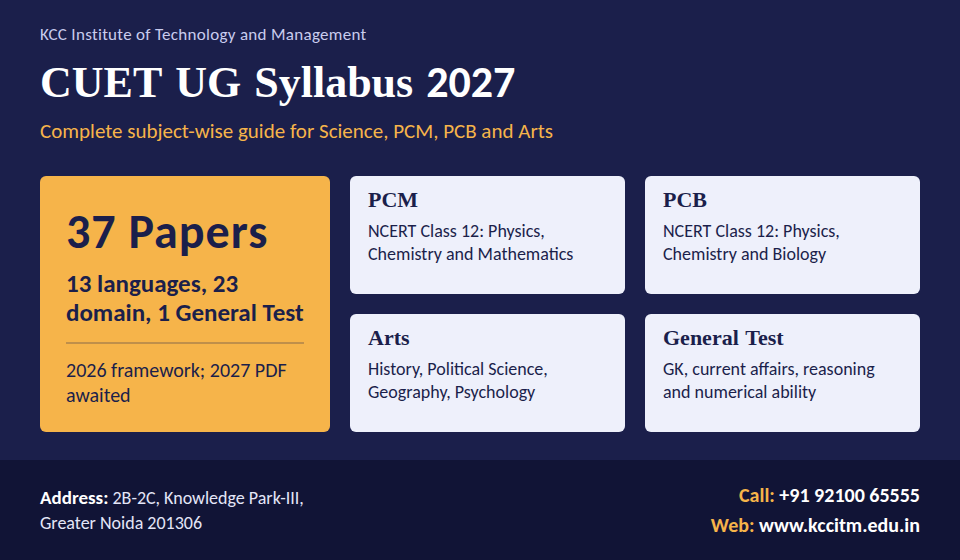

With the CUET UG 2027 cycle just around the corner, the syllabus — published annually by the National Testing Agency (NTA) — is the most crucial document to grasp before starting.
If you’re preparing for the CUET 2027 exam, this is the point where your plan begins. One test, over 240 universities, 37 disciplines — and your complete strategy relies on understanding precisely what comprises the CUET UG 2027 syllabus and exam pattern.
As of October 2026, the official CUET UG 2027 Syllabus and Information Bulletin have not been released by NTA on its CUET portal. The most recent official CUET UG syllabus for science, arts, and commerce streams that can be accessed is for CUET UG 2026.
This guide provides you with all essential information: a thorough CUET UG syllabus breakdown by section and stream, exam pattern, scoring system, important updates to be aware of, and our professional preparation approach for every section.
Previous Year Changes in the CUET Curriculum (Expected to Continue in 2027)
- Topics decreased from 63 to 37: Entrepreneurship, Teaching Skills, Legal Studies, Performing Arts, and various others were eliminated. Entry into those courses is now based on the General Aptitude Test score.
- No optional questions: Every one of the 50 questions is mandatory. No more choose-any-40 flexibility.
- No limitations on subjects: You can now select any CUET subject without considering what you learned in Class 12. A Science student may try History; a Commerce student may try Biology.
- General Test renamed: The General Test is now officially referred to as the General Aptitude Test (GAT) with an updated, more organized curriculum.
- Uniform duration: Each subject paper is now precisely 60 minutes.
What is the current status of the CUET UG 2027 Syllabus?
Right now, the UGC and the Ministry of Education are undertaking meetings and discussions with the NTA to bring foundational reforms into the CUET UG 2027 Syllabus and exam pattern while keeping the core subjects intact. However, there is no official confirmation of any such changes so far – only rumours.
Whatever changes may be planned for CUET UG 2027 will be disclosed by the NTA, probably in early January 2027.
Therefore, the CUET aspirants are recommended to carry on with their preparations according to the current syllabus and pattern available on the official website. Waiting for whatever changes may come in the future to plan your strategy accordingly will be a colossal waste of time that you can spend effectively on preparing for core subjects.
CUET UG 2027 at a Glance
| Feature | Details (based on the current pattern) |
| Conducting body | National Testing Agency (NTA) |
| Mode | Computer-based test (CBT) |
| Total test papers | CUET UG Syllabus 2027: Topics by Subject for Science, PCM, PCB, and Arts Students
A total of 37 subjects, including languages (13), specialized subjects (23), and a General Aptitude Test (1). |
| Subjects a candidate can pick | Up to 5 |
| Questions per paper | 50 MCQs – Mandatory |
| Time per paper | 60 minutes |
| Marks per paper | 250 |
| Marking scheme | +5 for a correct answer, -1 for a wrong one, 0 if unattempted |
| Syllabus base | NCERT books based on Class 11 and 12 |
| Official source | cuet.nta.nic.in |
In what way is the CUET UG Syllabus structured?
The syllabus isn’t just a single large list. It consists of three parts, and you create your own mix from them.
- Part I: Languages. The exam is available in 13 languages, including English, Hindi, Kannada, Malayalam, Assamese, Bengali, Gujarati, Tamil, Telugu, Marathi, Odia, Punjabi, and Urdu. Students will be evaluated in these languages via reading comprehension (factual, narrative, and literary texts), vocabulary, verbal skills, and grammar usage.
- Part II: Domain-specific areas: Twenty-three topics, all derived from the NCERT textbooks for those subjects. This is the point at which your Class 12 specialization is crucial, and where you will obtain most of your grades.
- Part III: General Ability Test (GAT). A single extensive exam covering general knowledge and contemporary issues, cognitive ability, numerical proficiency, quantitative evaluation, and logical thinking. Many universities mandate it, especially for BA, B.Com, and management-oriented courses.
Discussions Underway on Changes to CUET 2027 Exam Format
In October 2026, multiple news reports suggested that NTA, the UGC, and the Ministry of Education were considering a more efficient exam structure. The ideas presented include:
- Reducing the maximum number of subjects from five to four
- Shortening the time allotted for each paper from 60 minutes to approximately 40-45 minutes.
- Reducing the quantity of questions in each paper from 50 to about 35-40.
- Permitting a candidate to finish all selected exams in a single day.
This has not been confirmed yet. These are recommendations, not warnings. For your syllabus planning, it’s important that the content (the NCERT-based subjects) is reported to stay the same. Decreasing the number of questions in each paper would enhance the importance of every subject, so refrain from excluding any chapter in the hope that the paper will be more concise.
CUET UG Syllabus 2027 for Science: Essential Information for Science Students
The CUET UG syllabus 2027 for science is based on the NCERT Class 12 textbooks in Physics, Mathematics, Chemistry, and Biology, while also featuring elective subjects like Environmental Science, Agriculture, Anthropology, and Computer Science/Informatics Practices.
Various elements affect how students studying science ought to tackle the syllabus:
- All 50 questions must be answered. The earlier method of excluding some less strong chapters is now ineffective. Each unit can be either a potential score or a possible expense.
- The papers you take are determined by your chosen course. A Bachelor of Science. (Hons) Mathematics position anticipates Mathematics. A life-science position seeks Biology. Always check the university’s course eligibility before finalizing subjects.
- Language and GAT frequently accompany your domain publications. Think of them from the outset rather than regarding them as later additions.
Below are the distributions for the two conventional science streams, organized by unit.
CUET UG Syllabus 2027 for PCM Students
Participants choosing B.Sc. Physics, Chemistry, or Mathematics, combined programs, and computer-related subjects typically select Physics, Chemistry, and Mathematics. Below is a summary of what each paper addresses.
Physics (PCM and PCB)
Most published listings divide the Physics paper into ten sections.
| Unit | Core ideas to cover |
| 1. Electrostatics | Charge and Coulomb’s law, electric field and potential, dipoles, Gauss’s law applications, capacitors and dielectrics |
| 2. Current Electricity | Drift velocity, Ohm’s law, resistivity, cells and EMF, Kirchhoff’s laws, Wheatstone and metre bridge, potentiometer |
| 3. Magnetic Effects of Current and Magnetism | Biot-Savart law, Ampere’s law, force on moving charges and conductors, cyclotron, galvanometer, magnetic dipoles and materials |
| 4. Electromagnetic Induction and Alternating Currents | Faraday’s and Lenz’s laws, inductance, AC circuits, LCR resonance, transformers and generators |
| 5. Electromagnetic Waves | Displacement current, nature of EM waves, the electromagnetic spectrum and its uses |
| 6. Optics | Reflection and refraction, lenses, prisms, optical instruments, then wave optics: interference, diffraction, polarisation |
| 7. Dual Nature of Matter and Radiation | Photoelectric effect, Einstein’s equation, de Broglie wavelength |
| 8. Atoms and Nuclei | Rutherford and Bohr models, hydrogen spectrum, radioactivity, mass defect, fission and fusion |
| 9. Electronic Devices | Semiconductors, diodes and their applications, transistors, logic gates |
| 10. Communication Systems | Block diagram of a communication system, bandwidth, modulation (listed in some versions only) |
Note: Certain portals enumerate nine Physics units, while others count ten, as Communication Systems is included in some listings but not in others. The NTA PDF serves as the ultimate authority.
Analyses of the 2025 domain paper indicate that Electrostatics and Optics had approximately eight questions each, while Current Electricity and Electromagnetic Induction with Alternating Currents featured around seven questions each. These four sections can make up more than half of the document.
Chemistry (PCM and PCB)
The present Chemistry curriculum adheres to the condensed Class 12 NCERT format of ten units.
| Unit | Core ideas to cover |
| I. Solutions | Concentration terms, Raoult’s law, colligative properties, van’t Hoff factor |
| II. Electrochemistry | Galvanic cells, Nernst equation, conductance, Kohlrausch’s law, electrolysis |
| III. Chemical Kinetics | Rate laws, order and molecularity, half-life, Arrhenius equation, collision theory |
| IV. d- and f-Block Elements | Transition metal trends, properties of KMnO4 and K2Cr2O7, lanthanoids and actinoids |
| V. Coordination Compounds | Werner’s theory, naming, isomerism, bonding theories, applications |
| VI. Haloalkanes and Haloarenes | Nomenclature, nucleophilic substitution (SN1 and SN2), reactions and uses |
| VII. Alcohols, Phenols and Ethers | Preparation, physical and chemical properties, key conversions |
| VIII. Aldehydes, Ketones and Carboxylic Acids | Nucleophilic addition, named reactions, acidity of carboxylic acids |
| IX. Amines | Classification, basicity, diazonium salts and their synthetic use |
| X. Biomolecules | Carbohydrates, proteins, enzymes, vitamins, nucleic acids |
Outdated study guides continue to exist containing sections like Solid State, Surface Chemistry, p-Block Elements, and Polymers. If a PDF or video you are using presents these as mandatory, check it against the current NTA list before dedicating time to them.
In areas where marks have concentrated: the organic sections involving oxygen (alcohols, aldehydes, ketones, acids) accounted for roughly ten questions on the 2025 exam, while Electrochemistry, Solutions, Biomolecules, and d- and f-Block Elements contributed approximately five questions each.
Mathematics (PCM)
The fundamental Mathematics exam is split into six sections.
| Unit | Core ideas to cover |
| I. Relations and Functions | Types of relations and functions, inverse trigonometric functions |
| II. Algebra | Matrices, determinants, solving systems of equations |
| III. Calculus | Continuity and differentiability, applications of derivatives, integrals and their applications, differential equations |
| IV. Vectors and Three-Dimensional Geometry | Vector algebra, direction cosines and ratios, lines and planes in space |
| V. Linear Programming | Formulating problems, graphical solution, feasible regions |
| VI. Probability | Conditional probability, Bayes’ theorem, random variables and distributions |
Students selecting the applied-mathematics pathway should also review the distinct applied section, which focuses on numerical applications, index numbers, time-dependent data, and financial mathematics.
In areas of concentration: Matrices and Determinants (roughly ten questions) and Integrals (approximately nine) have dominated recent publications, while Continuity and Differentiability, Vector Algebra, Differential Equations, and Probability occupy the subsequent level.
CUET UG Syllabus 2027 for PCB Students
If you are pursuing a B.Sc. Life Sciences, Zoology, Botany, Biotechnology, Microbiology or related health-science programs, your core subjects are Physics, Chemistry, and Biology. Physics and Chemistry adhere to the unit lists mentioned above, therefore the new content here is Biology.
Biology / Biological Studies / Biotechnology / Biochemistry
The Biology document is structured into five units based on NCERT Class 12.
| Unit | Chapters and themes |
| I. Reproduction | Sexual reproduction in flowering plants (pollination, double fertilisation, seed and fruit formation), human reproduction (gametogenesis, menstrual cycle, embryo development), reproductive health (contraception, infertility treatments, STIs) |
| II. Genetics and Evolution | Principles of inheritance and variation, molecular basis of inheritance (DNA structure, replication, transcription, translation), evolution |
| III. Biology and Human Welfare | Human health and disease, microbes in human welfare, and food-production strategies in some listings |
| IV. Biotechnology and Its Applications | Principles and processes (recombinant DNA tools, PCR, vectors), applications in health, agriculture and industry |
| V. Ecology and Environment | Organisms and populations, ecosystems, and, in several listings, biodiversity, conservation, and environmental issues |
Details at the chapter level vary somewhat among available summaries, particularly for Units III and V, so verify the specific chapters in the official PDF.
Targeted attention for PCB candidates: Genetics and Evolution typically represents the most challenging unit, with Molecular Basis of Inheritance being one of the chapters with the most questions. Next follows reproduction. Biology benefits from diagram practice, so recreate the NCERT illustrations for the flower, embryo sac, male and female reproductive systems, and the lac operon until you can label them from memory.
CUET UG Syllabus 2027 for Arts Students
Humanities students have the widest menu of domain papers: History, Political Science, Geography, Sociology, Psychology, Economics, Mass Media/Mass Communication, Home Science, Physical Education, Sanskrit, Fine Arts, Performing Arts and Knowledge Traditions and Practices of India, besides the language papers. Most BA programmes ask for two or three of these along with a language and, often, the General Aptitude Test.
| Subject | What the syllabus is built on |
| History | NCERT Themes in Indian History, from Harappan cities and early states, through Buddhism, Bhakti-Sufi movements, Vijayanagara and the Mughal world, to colonial rule, the 1857 revolt, Gandhi, Partition and the making of the Constitution |
| Political Science | Contemporary World Politics (Cold War, globalisation, international organisations, security, environment) and Politics in India Since Independence (nation-building, planning, party systems, movements, regional issues) |
| Geography | Fundamentals of Human Geography (population, human activities, transport, communication, trade, settlements) and India: People and Economy (resources, agriculture, industry, planning, sustainable development) |
| Sociology | Indian Society (demography, institutions, inequality, diversity) and Social Change and Development in India (rural and industrial change, globalisation, media, social movements) |
| Psychology | Individual differences, self and personality, coping with life challenges, psychological disorders and therapies, attitudes and social cognition, group behaviour |
| Economics | Introductory microeconomics (demand, supply, producer behaviour, market forms) and macroeconomics (national income, money and banking, government budget, balance of payments) |
| English | Reading comprehension across passage types, verbal ability, sentence rearrangement, choosing the right word, synonyms, antonyms and vocabulary |
The precise chapter lists for each subject are available in the NTA subject PDFs, so refer to the table above for guidance and the official documents to mark off topics.
A recommendation for Arts aspirants: Exams in History, Political Science, and Geography value accuracy regarding dates, treaties, locations, and terminology. Create concise revision sheets for every NCERT chapter and review them weekly. One incorrect response deducts a point in addition to the five you failed to achieve.
Commerce Students: A Quick Look
This article focuses on science and Arts, but commerce students follow the same framework. Their typical domain papers include Accountancy (partnership accounts, corporate accounts, analysis of financial statements, computerized accounting), Business Studies (management principles, planning, organizing, staffing, directing, controlling, marketing, consumer protection, business finance), as well as Economics and Mathematics.
CUET Syllabus Common to Every Stream
English and Other Language Papers
Anticipate various types of passages accompanied by inquiries regarding theme, inference, and vocabulary meaning. Much of the remainder consists of vocabulary, sentence restructuring, error identification, and appropriate word selection. Reading daily is the most affordable and efficient way to prepare.
General Aptitude Test (GAT)
The GAT focuses on concepts at the school level and evaluates how effectively you utilize them. Prepare for:
- General knowledge and current affairs: Domestic and global occurrences, Honours, initiatives, government, geography, historical events
- Mathematical skills and quantitative analysis: percentages, ratios, averages, time and labour, profit and deficit, interest, measurement, algebra, statistics, data interpretation
- Analytical and logical reasoning: sequences, analogies, coding-decoding, syllogisms, riddles, seating patterns, family connections
Which Subject Combination Should You Choose?
The limit of five papers (or four if decreased) turns combinations into a genuine choice. Utilize these as foundational elements, then match them with the admission criteria of the universities you wish.
| Target area | Typical papers |
| B.Sc. Physics / Chemistry / Mathematics | Physics, Chemistry, Mathematics, English, GAT |
| B.Sc. Life Sciences / Biotechnology | Physics, Chemistry, Biology, English, GAT |
| BA (History, Political Science, Sociology) | History, Political Science, Sociology or Geography, English, GAT |
| BA (Economics) | Economics, Mathematics, English, GAT and one more as required |
| B.Com (Hons) | Accountancy, Business Studies or Economics, Mathematics, English, GAT |
The NTA framework does not link a domain paper to a Class 12 stream, allowing a PCM student to choose an Arts paper if permitted by a university. The limitation originates from the eligibility criteria of the university’s courses, not from CUET. Consistently verify the course page for every institution.
Using the Syllabus to Organize Your Study Plan
- Transform units into a tracker. Transfer each unit into a spreadsheet and denote three columns: studied, practiced, reviewed. Noticing colour discrepancies is more inspiring than a general sense of falling behind.
- Begin with NCERT and complete it. Domain questions are constructed based on the textbooks. Go through each chapter, highlight definitions and formulas, and answer the in-text and exercise questions before consulting any reference book.
- Value your time, but don’t overlook it. Allocate additional time to the challenging subjects, including Electrostatics, Optics, Organic Chemistry, Matrices and Integrals for science, or Genetics for biology. Also include the light units, as all questions are mandatory.
- Transition to earlier papers promptly. After completing a unit, address questions related to that specific unit only. This demonstrates the question format favoured by NTA, which is usually direct and rooted in NCERT.
- Complete comprehensive mock exams during the last stage. Rehearse the 60-minute, 50-question format to ensure you have time left for revisiting marked questions.
- Review periodically. A one-hour weekly review of past units is more effective than a hectic final week.
Negative Marking
Scoring +5 for a correct response and -1 for an incorrect one, a random guess on a four-choice question yields a positive expected value: (0.25 x 5) – (0.75 x 1) = +0.5 points. As every question is mandatory, the straightforward lesson is to always answer all questions and use elimination to enhance your chances further.
Typical Errors Students Commit Regarding the CUET Curriculum
- Adhering to obsolete lists. Chapters that were removed in recent years continue to be found in previous notes and videos. Consistently reference the most recent NTA PDF.
- Relying on summaries without questioning. Some online listings blend topics from different subjects. Utilize them for guidance, and depend on the official document for the conclusive list.
- Overlooking the fundamentals of Class 11. Many Class 12 subjects rely on concepts from Class 11, especially in Physics, Chemistry, and Biology.
- Selecting topics based solely on comfort. Choose papers that your ideal courses recognize, not just those you found enjoyable in school.
- Saving the GAT for last. For numerous universities, it holds significant importance, and preparation for current affairs requires months rather than days.
- Initiating practice exams too late. Speed and precision under a time constraint are abilities in their own right.
Method to Obtain the Official CUET UG Syllabus 2027
- Visit the official CUET UG site at cuet.nta.nic.in.
- Locate the Syllabus area on the homepage or within the candidate activity links.
- Select a topic, such as Physics, Chemistry, History, or the General Aptitude Test.
- Could you please share the content you’d like me to work on? Choose the edition of the language you favour.
- Obtain the PDF and store it. Place a hard copy next to your study desk.
Since the 2027 files were not made available during the writing, revisit this step immediately after the NTA announces the syllabus.
CUET UG Syllabus 2027 FAQs
Q1. When will the syllabus for CUET UG 2027 be published?
NTA has yet to establish a date. Education portals anticipate it by December 2026, with the Information Bulletin expected in early 2027.
Q2. Is the syllabus for CUET UG 2027 identical to that of 2026?
There has been no official announcement regarding any changes in content. As long as NTA does not indicate otherwise, the 2026 NCERT-based curriculum remains the most reliable reference.
Q3. What is the syllabus for CUET UG 2027 for students in Science?
It encompasses Physics, Chemistry, Mathematics, Biology, Computer Science, Environmental Science, Agriculture, and Anthropology, all aligned with the NCERT syllabus, along with the language subjects and the General Aptitude Test according to your program.
Q4. What subjects ought PCM students to select for CUET?
The majority select Physics, Chemistry, Mathematics, a foreign language (typically English), and the GAT. Align this with the qualifications of your desired courses.
Q5. What subjects are recommended for PCB students to choose in CUET?
Physics, Chemistry, and Biology are the typical selections, together with English and the GAT if necessary.
Q6. Which subjects are suitable for Arts students?
History, Political Science, Geography, Sociology, Psychology, and Economics are widely chosen, along with a language exam and the GAT.
Q7. Is NCERT sufficient for the CUET curriculum?
For the subject papers, NCERT serves as the basis and addresses nearly all of what is queried. Incorporate earlier papers and practice exams for precision and quickness.
Q8. Are all 50 questions mandatory in CUET UG?
Yes, following the current framework. Suggestions to reduce the length of the paper are merely reports at this point.
Q9. What is the number of subjects I can select in CUET UG 2027?
As many as five within the existing framework. A decrease to four is being considered but is not yet finalized.
Q10. Is the General Aptitude Test mandatory?
While it’s not mandatory for every course, numerous universities do request it, so review the eligibility section of your chosen institutions.
Final Thoughts
The CUET UG syllabus 2027 becomes more approachable when viewed as individual NCERT units instead of a massive challenge. Science students ought to base their plan on the PCM and PCB unit lists mentioned above, Arts students on their selected humanities subjects, and all students should maintain a consistent routine of study, practice, and revision.
Monitor the NTA website for the official announcement, verify each unit with the PDF, and note that the exam format might be adjusted even if the material remains consistent. Begin with the challenging topics, complete NCERT in detail, and allocate sufficient time for practice exams. Timely, organized readiness is the most reliable benefit you can establish.
Important Links:
CUET UG Result 2027: Expected Date, Direct Link, Scorecard & Latest Updates
CUET UG 2027 Exam Date: Registration, Eligibility, Admit Card, Syllabus and Result
CUET UG Syllabus 2027: Complete Subject-Wise Guide for Science, PCM, PCB and Arts
CUET UG 2027 Registration: Date, Last Date, Fees & How to Apply