

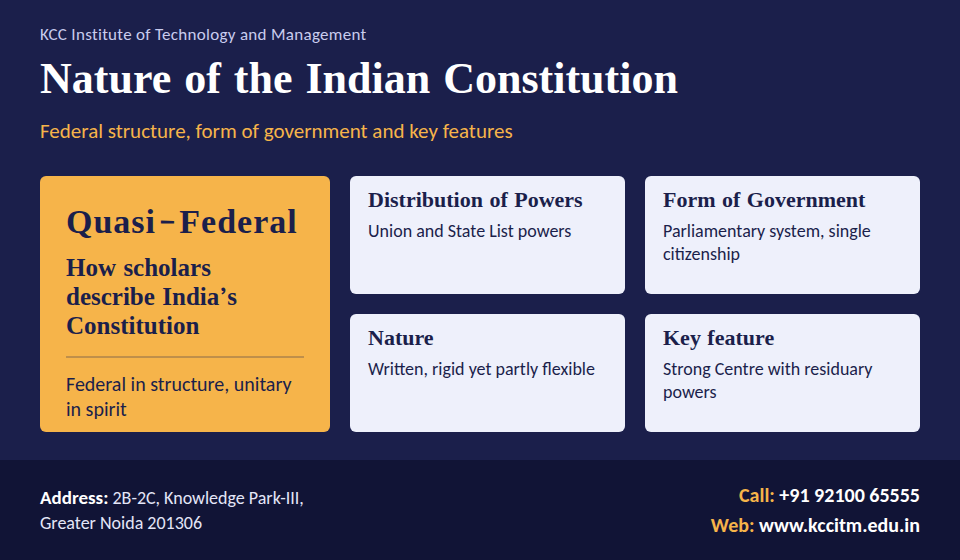

The nature of the Indian Constitution is best described as federal in structure but unitary in spirit. It divides power between the Union and the States, yet it tilts the balance towards the Centre. It is a written, lengthy document that sets up a parliamentary form of government and a sovereign, socialist, secular, democratic republic. Scholars usually call it quasi-federal.
Table of Contents
- What Do We Mean by the “Nature of the Constitution”?
- Unitary vs. Federal Constitution: The Basics
- Federal Structure of the Indian Constitution
- Unitary Features of the Indian Constitution
- Federal vs. Unitary Features at a Glance
- What Do Jurists and Courts Say?
- Form of Government in the Indian Constitution
- Other Defining Features of the Constitution
- Cooperative Federalism in Practice
- Recent Developments
- Conclusion
- FAQs
What Do We Mean by the “Nature of the Constitution”?
When lawyers, students and civil-service aspirants ask about the nature of the Constitution, they are asking how the document organises power. Is authority concentrated in one government, or shared among several? Who holds the final say when the Centre and a State disagree? How easily can the document be changed?
The nature of the Indian Constitution has drawn debate since the Constituent Assembly. The text never uses the word “federation”. Article 1 calls India a “Union of States”. Yet it also gives states their own legislatures, governments and a protected list of subjects. That mix is why the question keeps returning in law exams, UPSC papers and courtrooms.
To answer it properly, we need to look at two things. The first is the federal structure of the Constitution. The second is the form of government it creates. We will take both in turn.
Unitary vs. Federal Constitution: The Basics
Unitary constitution: All governing power sits with one central government. Regional units may exist, but they work only through what the Centre delegates. The United Kingdom is the standard example.
Federal constitution: Power is divided between a national government and regional governments. Each is supreme in its own field. The best-known examples are the United States, Canada, Australia and Switzerland.
Political scientists usually list these marks of a federation:
- A written constitution
- A division of powers between two levels of government
- Constitutional supremacy
- A rigid amendment process that involves the units
- An independent judiciary that settles disputes between the levels
Measured against this checklist, India scores well on most points. Where it departs, the departures are deliberate.
Federal Structure of the Indian Constitution
The federal structure of India rests on several pillars.
1. Dual polity
India has two levels of government, the Union and the States. Each has its own legislature and executive, and each draws its authority from the Constitution rather than from the other.
2. Written and supreme Constitution
The Constitution is the highest law. Under Article 13, any law that violates fundamental rights is void to that extent. Both Parliament and State legislatures must act within constitutional limits.
3. Division of powers
Article 246 and the Seventh Schedule split legislative subjects into three lists:
- Union List: subjects such as defence, foreign affairs, currency and railways, on which only Parliament legislates.
- State List: subjects such as police, public health and agriculture, on which State legislatures legislate.
- Concurrent List: subjects such as education, forests and criminal procedure, on which both can legislate. If the two conflict, the Union law generally prevails.
Powers that appear on no list are called residuary powers. Under Article 248, they belong to Parliament. This is another place where the Constitution leans towards the Centre. The framers took the idea of a Union-State-Concurrent split from the Government of India Act, 1935, and the idea of a Concurrent List from Canada and Australia.
4. Independent judiciary
The Supreme Court acts as the umpire of the federation. Under Article 131, it has original jurisdiction over disputes between the Union and States, or between States. Article 32 and Article 226 let courts strike down laws or actions that exceed constitutional limits.
5. Constitutional protection for federal provisions
Under Article 368(2), amendments that touch federal matters need more than a special majority in Parliament. They also need ratification by the legislatures of at least half the States. Examples include the distribution of legislative powers, representation of States in Parliament, and the Supreme Court’s powers. So Parliament cannot rewrite the federal bargain alone.
This point is often stated wrongly. The requirement is ratification by half of the States, not all of them.
6. Federalism as basic structure
In S.R. Bommai v. Union of India (1994), the Supreme Court treated federalism as part of the Constitution’s basic structure. The Court held that States are not mere appendages of the Centre. Their powers are their own within their sphere.
Unitary Features of the Indian Constitution
If India were a textbook federation, the story would end above. It does not, and the framers had reasons. The country had just been partitioned. Hundreds of princely states were being integrated. The framers wanted a Centre strong enough to hold the nation together.
1. “Union of States” and no right to secede
Article 1 describes India as a Union of States. Dr. B. R. Ambedkar explained in the Constituent Assembly that the word was chosen on purpose. The Indian federation is not the product of an agreement among States, and no State can leave it. The Union is indestructible, even though the States are not.
2. Parliament can reshape States
Under Articles 2 and 3, Parliament can, by ordinary law, admit new States, form new ones, change boundaries, merge States or change names. The affected State legislature must only be consulted, and its view is not binding. The creation of Telangana and the 2019 reorganisation of Jammu and Kashmir into two Union Territories show this power at work.
3. Single citizenship
Unlike the United States, India has no separate State citizenship. Every citizen owes allegiance to the Union alone.
4. Integrated judiciary
India has one integrated hierarchy of courts, with the Supreme Court at the top, High Courts below it and subordinate courts under them. There are no separate State supreme courts.
5. Governor appointed by the Centre
Under Article 155, the President appoints the Governor. Under Article 156, the Governor holds office during the President’s pleasure. The Governor can reserve certain Bills for the President under Article 200. This is a channel of central influence inside each State.
6. Emergency provisions
During a national emergency (Article 352), the Union gains the power to legislate on State subjects and to give directions to States. Under Article 356, the President can take over a State’s government when the constitutional machinery fails. Historically this power was used frequently, and often for political reasons, until the Supreme Court in S.R. Bommai made proclamations subject to judicial review.
7. Parliament can legislate on State subjects
Parliament can legislate on State List subjects in specific situations:
- Article 249: in the national interest, if the Rajya Sabha passes a resolution by a two-thirds majority
- Article 250: during a proclamation of emergency
- Article 252: when two or more States request it
- Article 253: to implement international treaties
8. Executive control
Article 256 requires States to exercise their executive power so as to comply with Union laws. Article 257 lets the Union give directions to States on certain matters. All-India Services (IAS, IPS) are recruited by the Centre but serve in the States, and Article 312 allows more to be created.
9. Financial dependence
The Centre controls the most productive sources of revenue. States rely heavily on tax devolution and grants, recommended by the Finance Commission. The result is that many States depend on the Union for money.
10. Unequal representation in the Rajya Sabha
The Rajya Sabha is often called the Council of States, but seats are allocated by population, not equally. Uttar Pradesh has 31 seats, while several smaller States have only one. In the United States Senate, every State gets two seats regardless of size.
11. Single election machinery and audit
The Election Commission runs elections to both Parliament and State legislatures. The Comptroller and Auditor General audits the accounts of both the Union and the States.
Federal vs. Unitary Features at a Glance
| Feature | Federal Character | Unitary Character |
|---|---|---|
| Governments | Union and State governments, each with own legislature | Centre can reorganise States (Arts. 2–3) |
| Powers | Three lists in the Seventh Schedule | Residuary powers with Parliament; Union prevails on Concurrent List |
| Constitution | Written and supreme | Amended mostly by Parliament alone |
| Amendment | Federal provisions need ratification by half the States | Most provisions need only a special majority in Parliament |
| Judiciary | Independent Supreme Court decides Centre-State disputes | Single integrated court system |
| Citizenship | (none) | Single citizenship |
| Governor | Constitutional head of the State | Appointed and removable by the Centre |
| Emergency | Bommai judgment allows judicial review | Union can take over State functions |
| Rajya Sabha | Represents States | Seats allotted by population |
| Services | State civil services exist | All-India Services controlled by Centre |
What Do Jurists and Courts Say?
There is no single agreed label. The main views are:
- K. C. Wheare called India quasi-federal: a unitary state with subsidiary federal features rather than the reverse.
- Sir Ivor Jennings described it as a federation with a strong centralising tendency.
- Granville Austin described India’s system as cooperative federalism, in which the Union and States work as partners and not rivals.
- Dr. B. R. Ambedkar said the Constitution is federal, but can operate as unitary in times of need.
- D. D. Basu concluded that it is basically federal, with striking unitary features.
The judiciary has also weighed in:
- State of West Bengal v. Union of India (1963): The Court observed that States are not sovereign, and that the Indian Constitution gives the Union strong powers.
- State of Rajasthan v. Union of India (1977): Justice Beg described the Constitution as “amphibian”, able to operate on a federal or a unitary plane as circumstances require.
- S.R. Bommai v. Union of India (1994): Federalism is a basic feature, and Article 356 is open to judicial review.
- Kuldip Nayar v. Union of India (2006): American-style federalism is not a template for India. Indian federalism is shaped by Indian needs.
- NCT of Delhi v. Union of India (2018 and 2023): The Court stressed cooperative federalism and the need for the Union and elected governments to respect each other’s domains.
The safest conclusion for an exam or a blog is this: India is a federation with a strong Centre. It is best called quasi-federal, cooperative federal or “federal in form, unitary in spirit”.
Form of Government in the Indian Constitution
The form of government is a separate question from federal vs. unitary. It asks how the executive and legislature relate, and how the head of state is chosen. The Constitution sets up the following.
Parliamentary democracy
India follows the parliamentary model, borrowed largely from Britain.
- The President is the nominal head of state. Under Article 74, the President acts on the advice of the Council of Ministers headed by the Prime Minister.
- The Council of Ministers is collectively responsible to the Lok Sabha (Article 75(3)). If it loses the confidence of the House, it must resign.
- Ministers are drawn from the legislature. The executive and legislature are closely linked, unlike in the presidential model of the United States.
- The same pattern applies in the States: the Governor is the nominal head, and the Chief Minister leads the Council of Ministers (Articles 163 and 164).
In Shamsher Singh v. State of Punjab (1974), the Supreme Court confirmed that the President and Governors are constitutional heads who act on ministerial advice, except in the limited situations where the Constitution gives them discretion.
Republic
India is a republic. The head of state is not hereditary. The President is elected indirectly for a five-year term by an electoral college of elected members of Parliament and State legislatures (Article 54).
Sovereign, Socialist, Secular, Democratic
The Preamble describes India as a Sovereign, Socialist, Secular, Democratic Republic. The words “socialist” and “secular” were added by the 42nd Amendment in 1976. Sovereignty means India is free of external control. Democracy is reflected in universal adult franchise and regular elections.
Parliamentary sovereignty balanced by judicial review
Britain’s Parliament is supreme. India’s is not. Parliament makes laws, but the courts can strike them down if they violate the Constitution. In Kesavananda Bharati v. State of Kerala (1973), the Supreme Court held that Parliament cannot alter the basic structure of the Constitution. That blend of parliamentary government and judicial review is characteristic of Indian democracy.
Other Defining Features of the Constitution
Written and lengthy
The Constitution was adopted on 26 November 1949 and came into force on 26 January 1950. It is one of the longest written constitutions in the world. As commonly cited, it now has about 448 articles, 25 parts and 12 schedules. Its length comes from detailed provisions on Centre-State relations, administration, and social and economic rights.
Blend of flexibility and rigidity
Under Article 368, some provisions can be amended by a simple majority (like changes to State names under Article 3). Most need a special majority: two-thirds of members present and voting, plus a majority of the total membership of each House. A few require ratification by half the States as well. This mix is neither wholly rigid like the US Constitution nor wholly flexible like the British one.
Fundamental Rights and Directive Principles
Part III guarantees enforceable fundamental rights. Part IV contains Directive Principles of State Policy, which guide governance but are not enforceable in court. Together they aim at both political liberty and social justice. (Link to your Fundamental Rights page here.)
Independent judiciary and judicial review
The Supreme Court and High Courts protect the Constitution and can invalidate laws and executive acts that violate it.
Secularism
The State treats all religions equally. It has no official religion.
Universal adult franchise
Every citizen aged 18 or above can vote (lowered from 21 by the 61st Amendment, 1988).
Cooperative Federalism in Practice
Reading only the text makes the Constitution look centralised. In practice, several institutions push the system towards partnership.
- Finance Commission (Article 280): appointed every five years to recommend how tax revenues are shared between the Union and the States.
- GST Council (Article 279A): created by the 101st Amendment in 2016. The Union and States decide GST rates and rules together, and neither can act alone.
- Inter-State Council (Article 263): a forum for consultation on matters of common interest.
- NITI Aayog: replaced the Planning Commission in 2015. Its Governing Council brings together Chief Ministers and Lieutenant Governors.
- Sarkaria and Punchhi Commissions: two commissions that studied Centre-State relations and recommended reforms on the role of Governors, use of Article 356 and sharing of powers.
Recent Developments
Article 370 verdict (December 2023)
The Supreme Court upheld the 2019 decision to abrogate Article 370 and reorganise Jammu and Kashmir into Union Territories. The case reopened debate about how far the Union can restructure a State, and about how Articles 2 and 3 fit with federalism.
Governor’s assent to Bills (2025)
In April 2025, a two-judge bench in the Tamil Nadu Governor case fixed timelines for Governors and the President to act on Bills. The President then made a reference under Article 143. On 20 November 2025, a five-judge Constitution Bench gave its opinion. It said Governors and the President cannot be bound by rigid, judicially imposed timelines and there is no “deemed assent”. It also held that Governors do not have unfettered power to sit on Bills indefinitely, and that courts can step in where inaction is unexplained and prolonged.
For students, the point is that the Governor’s office remains one of the most contested spots on the federal map.
Conclusion
The nature of the Indian Constitution cannot be captured in one word. It creates a dual polity, divides powers through the Seventh Schedule, protects federal provisions through Article 368(2), and gives the judiciary the role of umpire. At the same time, it lets Parliament redraw States, gives the Centre residuary and emergency powers, appoints Governors from above, and keeps a single citizenship and an integrated judiciary.
That is why the best summary is the one the Constituent Assembly itself gave: a Union that is flexible enough to work as a federation in normal times and to act as a unitary state when the nation’s unity is at stake. Alongside this, the Constitution sets up a parliamentary form of government within a sovereign, socialist, secular, democratic republic.
Whether you call it quasi-federal, cooperative federal or federal with a unitary bias, one thing is clear. Indian federalism was designed for Indian conditions, and it keeps evolving through judgments, commissions and political practice.
Frequently Asked Questions (FAQs)
Q1. What is the nature of the Indian Constitution?
The Indian Constitution is federal in structure and unitary in spirit. It divides powers between the Union and the States but gives the Centre greater strength, especially in emergencies. Jurists commonly call it quasi-federal. It is also a written, lengthy constitution that sets up a parliamentary form of government.
Q2. Is the Indian Constitution federal or unitary?
It is neither purely federal nor purely unitary. It has federal features such as a written constitution, the Seventh Schedule division of powers and an independent judiciary. It also has unitary features such as single citizenship, an integrated judiciary and emergency powers. Hence it is described as quasi-federal.
Q3. Why is the word “federation” not used in the Constitution?
Article 1 calls India a “Union of States”. Dr. Ambedkar explained that India’s federation is not the result of an agreement among States, and no State has a right to secede. The word “Union” signals that the country is indivisible.
Q4. What is the federal structure of the Indian Constitution?
It refers to the sharing of power between the Union and the States. This includes a dual polity, three legislative lists in the Seventh Schedule, an independent Supreme Court to settle disputes, and a special amendment procedure for federal provisions.
Q5. What is the form of government in India?
India has a parliamentary form of government in a republic. The President is the nominal head. Real executive power lies with the Council of Ministers led by the Prime Minister, which is collectively responsible to the Lok Sabha. The same model applies in the States.
Q6. Who called the Indian Constitution quasi-federal?
K. C. Wheare described it as quasi-federal, meaning a unitary state with subsidiary federal features. Other scholars, like Ivor Jennings, described it as a federation with a strong centralising tendency.
Q7. What are the main unitary features of the Indian Constitution?
The main ones are the Union of States concept, Parliament’s power to alter State boundaries, single citizenship, integrated judiciary, Governors appointed by the Centre, emergency provisions, residuary powers with the Centre, All-India Services and unequal representation in the Rajya Sabha.
Q8. How can the Constitution be amended, and does it involve the States?
Under Article 368, most amendments need a special majority in Parliament. Amendments affecting federal provisions also need ratification by the legislatures of at least half the States.
Q9. Is federalism part of the basic structure?
Yes. In S.R. Bommai v. Union of India (1994), the Supreme Court recognised federalism as part of the basic structure of the Constitution.
Q10. What is cooperative federalism in India?
It is the idea that the Union and States work together instead of competing. Institutions like the Finance Commission, GST Council, Inter-State Council and NITI Aayog reflect this approach.
Q11. How is India’s federalism different from that of the United States?
In the US, States come together voluntarily and have dual citizenship, separate court systems and equal Senate representation. In India, the Union is indestructible, there is single citizenship, an integrated judiciary and unequal Rajya Sabha seats, and Parliament can alter State boundaries.
Q12. Why did the framers give India a strong Centre?
The country had just been partitioned, and hundreds of princely states were being integrated. The framers felt a strong Centre was needed to preserve national unity and hold a diverse country together.