
If you are preparing for JEE Main, one of the first things to settle is the paper’s size. Knowing how many questions are there in JEE Main, and how they split across subjects, lets you plan your time, practice and attempt strategy.
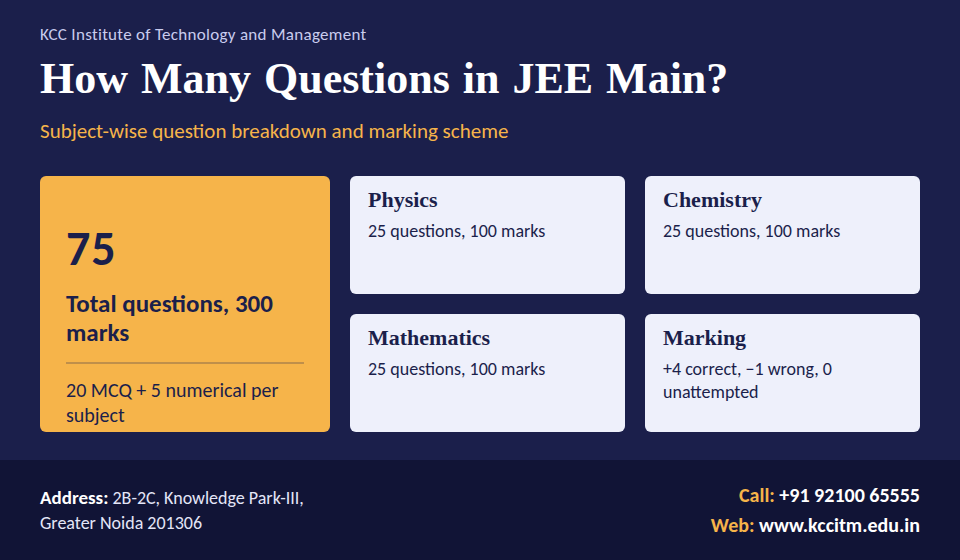
The short answer: JEE Main Paper 1 (B.E./B.Tech) has 75 questions for 300 marks, with 25 each from Physics, Chemistry and Mathematics. All 75 are compulsory to appear for, and you are given three hours.
Note: NTA’s official bulletin for JEE Main 2027 was still awaited at the time of writing. The pattern below follows the format used since 2025 and is widely expected to continue. Check jeemain.nta.nic.in before you finalise your plan.
JEE Main Paper 1: Quick Snapshot
| Feature | Details |
|---|---|
| Course | B.E. / B.Tech |
| Mode | Computer-Based Test |
| Duration | 3 hours (4 hours for PwD candidates) |
| Total questions | 75 |
| Total marks | 300 |
| Marks per question | 4 |
| Negative marking | −1 for a wrong answer |
| Unattempted | 0 marks |
How Many Questions Are There in JEE Main Subject-Wise?
Every subject gets the same share of the paper. Each one is split into two sections:
- Section A: 20 multiple-choice questions (MCQs)
- Section B: 5 numerical-value questions (NVQs), where you type the answer using an on-screen keypad
| Subject | Section A (MCQ) | Section B (Numerical) | Total Questions | Marks |
|---|---|---|---|---|
| Physics | 20 | 5 | 25 | 100 |
| Chemistry | 20 | 5 | 25 | 100 |
| Mathematics | 20 | 5 | 25 | 100 |
| Total | 60 | 15 | 75 | 300 |
So the subject-wise count is simple: three subjects, 25 questions each, 100 marks each. What changes from shift to shift is how difficult and how lengthy those questions are.
How Many Questions Are There in JEE Mains Physics?
Physics contributes 25 questions worth 100 marks: 20 MCQs and 5 numerical-value questions.
These questions come from the Class 11 and 12 syllabus. Expect a mix of:
- Concept-based questions that test your understanding of a law or principle
- Formula-based problems that need a quick calculation
- Multi-concept questions that join two or three chapters
- Graph-, unit- and dimension-based questions
The heavier areas are generally Mechanics, Electrodynamics and Modern Physics, and together they account for most of the section. Your numerical-value questions in Physics also carry a penalty if wrong, so check your units and rounding before you submit.
How Many Questions Are There in JEE Mains from Organic Chemistry?
This is where many students get confused, because there is no fixed number. NTA publishes the total for Chemistry (25 questions) but does not declare how many come from Organic, Physical or Inorganic.
What previous shifts show is that the split moves around:
- Some shifts have leaned towards Physical Chemistry, with roughly 12 to 14 questions, leaving Organic at about 8 to 9.
- Other shifts have been Inorganic-heavy, with Organic having comparatively fewer questions.
- Over many papers, the three branches are often described as broadly comparable, with one branch sometimes picking up a few extra questions.
A reasonable planning assumption is that Organic Chemistry can bring in around 7 to 9 questions in a typical shift, which is roughly 28 to 36 marks. Treat that as an approximate guide, not a guarantee.
Organic questions usually come from:
- General Organic Chemistry (GOC) and reaction mechanisms
- Hydrocarbons and haloalkanes
- Compounds containing oxygen and nitrogen
- Biomolecules, polymers and everyday-life chemistry
How Many Questions Are There in JEE Mains from Physical Chemistry?
Physical Chemistry follows the same rule: no official count, and the number varies between shifts. In some 2026 shifts it was the largest block of Chemistry, and in others it was moderate.
You can reasonably expect around 8 to 10 questions from it, and a large share are calculation-based, including numerical-value questions. Typical topics are:
- Mole concept and stoichiometry
- Chemical and ionic equilibrium
- Thermodynamics and thermochemistry
- Chemical kinetics and electrochemistry
- Solutions and atomic structure
Why it matters: Physical Chemistry tends to be among the more scoring parts of Chemistry for students who practise numericals regularly, so it rewards steady problem-solving.
What About Inorganic Chemistry?
Inorganic makes up the rest of the 25 questions. Many of them are NCERT-based, covering periodic properties, chemical bonding, coordination compounds, d- and f-block elements and salt analysis. Since these are largely theory questions, they can be answered quickly if your NCERT revision is solid.
Chemistry Question Distribution at a Glance
| Chemistry Branch | Typical Range per Shift (approx.) | Nature of Questions |
|---|---|---|
| Physical Chemistry | 8–10 (can go higher) | Numerical, formula-driven |
| Organic Chemistry | 7–9 | Mechanism and reaction-based |
| Inorganic Chemistry | 7–9 (can go higher) | NCERT theory-based |
| Total | 25 |
These ranges are indicative, based on observed trends across shifts. Always follow the official syllabus instead of banking on any one split.
Marking Scheme: What Each Question Is Worth
Each question carries 4 marks, regardless of subject or type.
| Outcome | MCQ | Numerical |
|---|---|---|
| Correct | +4 | +4 |
| Incorrect | −1 | −1 |
| Not attempted | 0 | 0 |
Negative marking applies to both sections, so a wrong numerical answer costs a mark too.
Worked example: Suppose you answer 45 questions correctly, 15 incorrectly and skip 15.
Score = (45 × 4) − (15 × 1) = 180 − 15 = 165 out of 300.
Remember that this is your raw score. NTA converts raw scores into percentiles through normalisation, because the exam runs in multiple shifts.
Are All 75 Questions Compulsory?
Yes, there is no choice of questions in the current pattern. You can skip a question, but there are no optional questions to pick from.
This is a change from the earlier format. From 2021 to 2024, each subject had 30 questions (20 MCQs plus 10 numericals), and candidates attempted any 5 of the 10 numericals. That meant 90 questions were printed and 75 were answered. Since 2025, the paper has had 75 questions, with 5 numericals per subject.
JEE Main Paper 2A and 2B: Number of Questions
If you are applying for architecture or planning, the paper is different:
| Paper | Course | Questions | Marks |
|---|---|---|---|
| Paper 2A | B.Arch | 77 (25 Maths including 5 numericals, 50 Aptitude, 2 Drawing) | 400 |
| Paper 2B | B.Planning | 100 (25 Maths including 5 numericals, 50 Aptitude, 25 Planning) | 400 |
Time Management: Making 75 Questions Work in 3 Hours
With 180 minutes for 75 questions, you get an average of about 2.4 minutes per question. In practice, you should not spend equal time on everything:
- First pass: Solve the questions you are sure about, usually the direct and theory-based ones.
- Second pass: Take on questions that need moderate calculation.
- Final pass: Return to the tough ones only if time remains.
Inorganic and many Physics concept questions are often quicker, which can bank time for lengthy Maths or Physical Chemistry numericals. Full-length mock tests are the best way to find your own ideal order.
Key Takeaways
- JEE Main Paper 1 has 75 questions for 300 marks.
- Physics, Chemistry and Maths each have 25 questions (20 MCQs + 5 numericals).
- Chemistry’s split between Organic, Physical and Inorganic is not fixed and changes from shift to shift.
- Every question is worth +4, with −1 for wrong answers in both sections.
- There are no optional questions in the current pattern.
FAQs
1. How many questions are there in JEE Main?
JEE Main Paper 1 has 75 questions: 25 in Physics, 25 in Chemistry and 25 in Mathematics, for 300 marks.
2. How many questions are there in JEE Mains Physics?
There are 25 Physics questions, made up of 20 multiple-choice and 5 numerical-value questions, worth 100 marks.
3. How many questions come from Organic Chemistry in JEE Mains?
NTA does not fix this number. Past shifts suggest roughly 7 to 9 questions, though it can differ by shift.
4. How many questions come from Physical Chemistry in JEE Mains?
It also varies. Around 8 to 10 is a reasonable expectation, and in some shifts it has been higher.
5. How many numerical-value questions are there in JEE Main?
There are 15 in total, 5 in each subject.
6. Is there negative marking for numerical questions?
Yes. A wrong numerical answer costs 1 mark, the same as a wrong MCQ.
7. How many questions are there in JEE Main Paper 2A and 2B?
Paper 2A (B.Arch) has 77 questions and Paper 2B (B.Planning) has 100 questions, both for 400 marks.