
The JEE Main syllabus covers Physics, Chemistry and Mathematics from the NCERT Class 11 and Class 12 courses. Paper 1 (B.E./B.Tech) carries 75 questions for 300 marks. Only the National Testing Agency (NTA) publishes the official syllabus.
Status update (October 2026): NTA hasn’t yet published a separate syllabus PDF for the January and April 2027 sessions. The 2026 syllabus is the safest guide, and the 2027 document is expected with the information bulletin. Check jeemain.nta.nic.in for the final version.
What the JEE Main syllabus actually is
The syllabus is the official list of units and topics from which NTA sets the paper. Any question must connect to something on that list. That’s why serious aspirants read it before they buy a single book.
JEE Main has three papers:
- Paper 1: B.E./B.Tech, with Physics, Chemistry and Mathematics.
- Paper 2A: B.Arch, with Mathematics, Aptitude and Drawing.
- Paper 2B: B.Planning, with Mathematics, Aptitude and Planning-based questions.
Is the JEE Main syllabus changing for 2027?
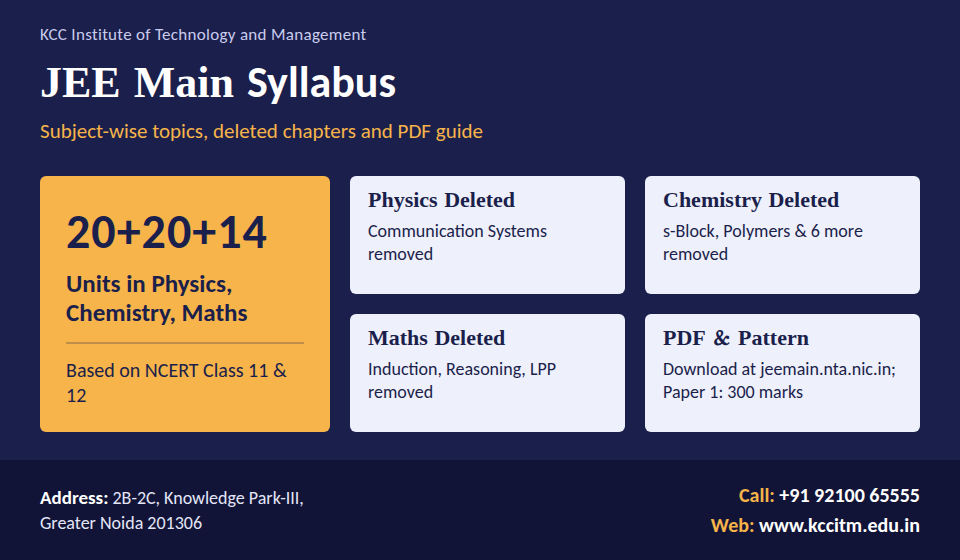
No major change is expected. NTA trimmed the syllabus in recent cycles to align it more closely with NCERT, and the 2026 structure (20 units in Physics, 20 in Chemistry, 14 in Maths) has stayed stable since. Prepare from the 2026 list, then compare it with the 2027 PDF when it appears.
JEE Main syllabus 2027 for Physics
Physics has 20 units, including Experimental Skills. They fall into five rough clusters:
- Mechanics: units and measurements, kinematics, laws of motion, work-energy-power, rotational motion, gravitation.
- Matter and heat: properties of solids and liquids, thermodynamics, kinetic theory of gases.
- Waves: oscillations and waves.
- Electricity and magnetism: electrostatics, current electricity, magnetic effects of current and magnetism, electromagnetic induction and alternating currents, electromagnetic waves.
- Optics and modern physics: optics, dual nature of matter and radiation, atoms and nuclei, electronic devices.
The last unit, Experimental Skills, lists 18 experiments. They include the Vernier calliper, screw gauge, Young’s modulus, the metre bridge, the prism deviation graph and diode characteristics. Many students skip this unit and lose easy marks.
Removed: Communication Systems is no longer part of the syllabus.
JEE Main syllabus 2027 for Chemistry
Chemistry has 20 units across three branches.
Physical Chemistry (8 units): some basic concepts, atomic structure, chemical bonding, chemical thermodynamics, solutions, equilibrium, redox reactions and electrochemistry, and chemical kinetics.
Inorganic Chemistry (4 units): periodic classification, p-block elements, d- and f-block elements, and coordination compounds.
Organic Chemistry (8 units): purification and characterisation, basic principles of organic chemistry, hydrocarbons, compounds containing halogens, oxygen and nitrogen, biomolecules, and principles related to practical chemistry.
The practical chemistry unit covers more than students expect: detecting elements and functional groups, qualitative salt analysis, titrations, preparing Mohr’s salt and potash alum, and enthalpy experiments.
Removed: States of Matter, Surface Chemistry, Hydrogen, s-Block Elements, Isolation of Metals, Environmental Chemistry, Polymers and Chemistry in Everyday Life.
JEE Main syllabus 2027 for Mathematics
Mathematics has 14 units. Maths looks lighter on paper, but its units are large.
| Group | Units |
|---|---|
| Algebra | Sets, relations and functions; complex numbers and quadratic equations; matrices and determinants; permutations and combinations; binomial theorem; sequence and series |
| Calculus | Limit, continuity and differentiability; integral calculus; differential equations |
| Geometry | Coordinate geometry; three-dimensional geometry; vector algebra |
| Others | Statistics and probability; trigonometry |
Removed: Mathematical Induction, Mathematical Reasoning and Linear Programming.
Deleted topics at a glance
| Subject | Not in the current syllabus |
|---|---|
| Physics | Communication Systems |
| Chemistry | States of Matter, Surface Chemistry, Hydrogen, s-Block, Isolation of Metals, Environmental Chemistry, Polymers, Chemistry in Everyday Life |
| Maths | Mathematical Induction, Mathematical Reasoning, Linear Programming |
Older blogs and some coaching pages still list these chapters, so double-check any resource you use against the NTA PDF.
Paper 2 syllabus (B.Arch and B.Planning)
Both Paper 2A and Paper 2B use the same Mathematics syllabus as Paper 1 and share an Aptitude Test. The Aptitude Test checks visual perception, awareness of buildings and materials, 3D visualisation, scale and proportion, and reasoning.
- B.Arch adds a Drawing Test: sketching urban scenes, landscapes and rural life from memory.
- B.Planning adds a Planning section: general awareness about cities and development, social science (the Constitution, federalism, urbanisation, resources, poverty) and thinking skills such as map reading and reading charts.
JEE Main exam pattern in Brief
Paper 2A (B.Arch)
| Part | Subject | Mode | Questions | Marks |
|---|---|---|---|---|
| I | Mathematics | CBT | 25 (20 MCQ + 5 numerical) | 100 |
| II | Aptitude Test | CBT | 50 MCQ | 200 |
| III | Drawing Test | Pen and paper (A4 sheet) | 2 | 100 (50 each) |
| Total | 77 | 400 |
Paper 2B (B.Planning)
| Part | Subject | Mode | Questions | Marks |
|---|---|---|---|---|
| I | Mathematics | CBT | 25 (20 MCQ + 5 numerical) | 100 |
| II | Aptitude Test | CBT | 50 MCQ | 200 |
| III | Planning-Based Test | CBT | 25 MCQ | 100 |
| Total | 100 | 400 |
Quick comparison: Paper 1 vs Paper 2A vs Paper 2B
| Point | Paper 1 (B.E./B.Tech) | Paper 2A (B.Arch) | Paper 2B (B.Planning) |
|---|---|---|---|
| Subjects | Physics, Chemistry, Maths | Maths, Aptitude, Drawing | Maths, Aptitude, Planning |
| Total questions | 75 | 77 | 100 |
| Total marks | 300 | 400 | 400 |
| Exam mode | CBT | CBT + pen-and-paper (Drawing) | CBT |
| Duration | 3 hours | 3 hours | 3 hours |
| Correct answer | +4 | +4 (MCQ and numerical) | +4 |
| Wrong answer | -1 | -1 (MCQ and numerical) | -1 |
Duration
| If you appear for | Standard duration | For PwD candidates |
|---|---|---|
| Paper 2A only | 3 hours | 4 hours |
| Paper 2B only | 3 hours | 4 hours |
| Both 2A and 2B | 3 hours 30 minutes | 4 hours 10 minutes |
Which chapters deserve priority?
NTA does not publish chapter-wise weightage. Every table online is an estimate from past papers, and some sites base theirs on the old 30-question pattern. Use the trends below to order your study, not to skip anything.
- Physics: Current Electricity, Electrostatics, Optics, Electromagnetic Induction and AC, Modern Physics, Thermodynamics and Rotational Motion appear often.
- Chemistry: Chemical Bonding, Equilibrium, Electrochemistry, p-Block, Coordination Compounds and oxygen-containing organic compounds are regular scorers.
- Maths: Coordinate Geometry, Calculus, Matrices and Determinants, and Probability usually carry the most questions.
A “low priority” chapter can still bring a full 4 marks, so cover every unit at least once.
How to download the JEE Main syllabus PDF
- Visit the official NTA JEE Main website, jeemain.nta.nic.in.
- Open the Information Bulletin or Syllabus section.
- Choose Paper 1 or Paper 2.
- Download the PDF and save a copy. A Hindi version is also published.
JEE Main vs JEE Advanced syllabus
They are separate. JEE Main is set by NTA and leads to NITs, IIITs and other centrally funded institutes. JEE Advanced is run by one of the IITs on rotation and has its own syllabus on its official site. You must qualify through JEE Main to be eligible for JEE Advanced.
How to use the syllabus in your preparation
- Print it and tick off each unit as you finish it.
- Start with NCERT, then move to problem books for Physics and Maths.
- Skip deleted chapters so you don’t waste weeks on them.
- Match each unit with previous-year questions to see how NTA frames them.
- Keep the last month for mock tests and revision cycles.
Frequently asked questions
What is the JEE Main syllabus?
It’s the NTA-defined list of Physics, Chemistry and Mathematics units from NCERT Class 11 and 12, with extra Aptitude, Drawing or Planning parts for Paper 2.
Has NTA released the JEE Main 2027 syllabus?
Not yet. The 2026 syllabus is the reference, and the 2027 PDF is expected with the information bulletin.
How many units are in the JEE Main syllabus?
Physics has 20, Chemistry has 20 and Maths has 14.
Is the syllabus the same for the January and April sessions?
Yes. One syllabus covers both sessions.
Which topics were deleted from the JEE Main syllabus?
Communication Systems in Physics, several Chemistry chapters (such as s-Block, Surface Chemistry and Polymers), and Mathematical Induction, Mathematical Reasoning and Linear Programming in Maths.
Are experiments part of the syllabus?
Yes. Physics has 18 listed experiments, and Chemistry has a practical unit.
Is the JEE Main syllabus the same as JEE Advanced?
No. JEE Advanced has its own syllabus.
Where can I get the official PDF?
From the NTA JEE Main website, jeemain.nta.nic.in.