
JEE Main Eligibility Criteria 2027: Age Limit, 12th Percentage, Subjects, Attempts and Registration Fees

The National Testing Agency (NTA) released the official Information Bulletin for JEE Main 2027 on 24 October 2026, and Session 1 applications are already open. Before you fill the form, make sure you actually qualify. A wrong passing year or a missing subject can cost you an entire attempt. This guide covers the JEE Main eligibility criteria 2027 as per the official bulletin: who can apply, what the 12th-percentage rule really means, how many chances you get, and what you will pay.
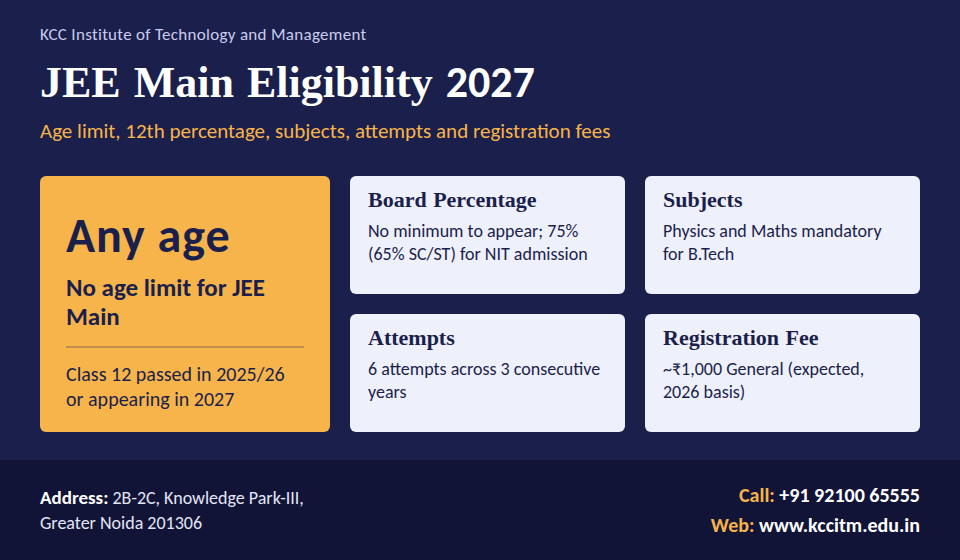
JEE Main Eligibility Criteria 2027: Quick Summary
| Parameter | What applies |
|---|---|
| Conducting body | National Testing Agency (NTA) |
| Class 12 passing year | 2025, 2026, or appearing in 2027 |
| Age limit | None |
| Attempts | 3 consecutive years, 2 sessions per year (up to 6 chances) |
| Minimum 12th marks to appear | None |
| Minimum marks for NIT/IIIT/GFTI admission | 75% (65% for SC/ST/PwD) or top 20 percentile of your board |
| Core subjects for B.E./B.Tech | Physics and Mathematics, plus one more approved subject |
JEE Main 2027 Important Dates
| Event | Session 1 (January) | Session 2 (April) |
|---|---|---|
| Application window | 24 Oct – 22 Nov 2026 | 5 Jan – 3 Feb 2027 |
| Last date for fee payment | 22 Nov 2026 | 3 Feb 2027 |
| Late application (₹500 late fee) | 23 – 26 Nov 2026 | 4 – 7 Feb 2027 |
| Correction window | 27 – 29 Nov 2026 | 8 – 10 Feb 2027 |
| City intimation slip | 30 Dec 2026 | 12 Mar 2027 |
| Admit card | 13 Jan 2027 | 25 Mar 2027 |
| Exam dates | 20, 21, 22, 23, 24, 28 Jan 2027 | 2, 3, 4, 5, 6, 7 Apr 2027 |
All deadlines run until 11:50 PM on the last date.
Who Can Apply for JEE Main 2027?
Your eligibility mainly depends on the year you cleared, or will clear, Class 12 or an equivalent exam. Three groups can apply:
- Class 12 students of 2026–27, who will take their board exams in 2027.
- 2026 pass-outs, who finished school this year.
- 2025 pass-outs, including droppers still preparing.
Students who cleared Class 12 in 2024 or earlier are not eligible for the 2027 cycle. The year your result was declared counts as your passing year.
A student who failed in earlier years but passed in 2026, even as a private candidate, can still apply for 2027.
Is There an Age Limit for JEE Main 2027?
No. Age does not affect your right to take the exam. One caution: NTA says candidates may still have to meet the age rules of the specific institute they want to join, so check those during counselling.
How Many Attempts Are Allowed?
JEE Main runs in two sessions every year, January and April. You may appear in one or both. The window covers three consecutive years from your Class 12 year, which gives up to six chances (3 years × 2 sessions). Taking both sessions is optional, and your better score is used for the rank list.
For 2027, Session 1 is scheduled for January 22, 23, 24, 28, 29 and 30, 2027, with Session 2 expected in April.
JEE Mains Eligibility Criteria 12th Percentage: What You Actually Need
This is the most common confusion among students.
To appear in the jee main exam: there is no minimum percentage. A student with 55% in boards can write JEE Main as long as the passing-year and subject rules are met.
To get admission in NITs, IIITs and other centrally funded institutes (via JoSAA/CSAB): the Class 12 marks matter. You need one of the following:
- At least 75% aggregate in Class 12th (65% for SC, ST and PwD candidates), or
- A place in the top 20 percentile of successful candidates in your board, calculated category-wise.
Your board result therefore does not stop you from taking the exam, but it can stop you from taking a seat. If your marks are borderline, check your board’s top-20-percentile cutoff when it is published.
Programme-specific marks rules also apply:
- B.Arch: about 45% aggregate in Class 12 (or a 10+3 diploma with 45% in Mathematics).
- B.Planning: 50% in Mathematics and 50% aggregate.
Subject Requirements in Class 12
| Paper | Programme | Subjects needed |
|---|---|---|
| Paper 1 | B.E./B.Tech | Physics, Mathematics, a language, one of Chemistry/Biotechnology/Biology/Technical Vocational subject, and one more subject |
| Paper 2A | B.Arch | Physics, Chemistry, Mathematics, plus two other subjects |
| Paper 2B | B.Planning | Mathematics plus four other subjects |
For most engineering aspirants, Physics, Chemistry and Mathematics is the safest combination. A diploma holder cannot sit for B.Arch in place of Class 12 with PCM.
Qualifying Examinations Accepted by NTA
You are considered eligible if you passed any of these:
- Class 12 of a central or state board (CBSE, CISCE, state boards)
- Intermediate or two-year Pre-University exam
- Final exam of the two-year Joint Services Wing course of the National Defence Academy
- NIOS Senior Secondary exam with at least five subjects
- Any Indian or foreign exam recognised as equivalent to 10+2 by the Association of Indian Universities (AIU)
- Higher Secondary Certificate (Vocational) exam
- A three-year diploma recognised by AICTE or a state technical board
- GCE Advanced (A) level from London, Cambridge or Sri Lanka
- Cambridge High School Certificate or IB Diploma
Candidates with foreign qualifications should arrange the AIU equivalence certificate early.
Nationality Rules
Indian citizens can apply, and NRIs, PIOs, OCIs and foreign nationals are also allowed to take the exam. OCI/PIO candidates who passed Class 12 abroad compete only for All India or Other State seats in NITs and other CFTIs, not Home State seats.
State Code of Eligibility
Your state code is the state where you passed Class 12, not your native place or current address. For example, a student who passed Class 12 in Delhi but lives in Noida gets the Delhi code, not UP. Other points to remember:
- If you appear for an improvement examination in a different state, your original state of passing will still be considered.
- NIOS students choose the state of their study centre.
- Indian nationals who passed Class 12 in Nepal or Bhutan use the permanent address on their passport.
This code decides your Home State quota in NITs and similar institutes, so enter it carefully.
Reservation Under JEE Main 2027
| Category | Reservation |
|---|---|
| SC | 15% |
| ST | 7.5% |
| OBC-NCL | 27% |
| GEN-EWS | 10% |
| PwD | 5% (horizontal) |
OBC-NCL and EWS candidates must hold valid certificates in the prescribed format. EWS status requires annual family income below ₹8 lakh along with the other asset conditions.
JEE Mains 2027 Registration Fees
NTA has not announced the 2027 fee yet. The figures below are based on the latest published structure, so verify them in the bulletin. The fee is non-refundable and is paid online by card, net banking or UPI. Banks or gateways may add processing charges and GST.
JEE Mains 2027 Registration Fees
| Category | Centres in India | Centres outside India |
|---|---|---|
| General: male | ₹1,000 | ₹5,000 |
| General: female | ₹800 | ₹4,000 |
| Gen-EWS/OBC-NCL: male | ₹900 | ₹4,500 |
| Gen-EWS/OBC-NCL: female | ₹800 | ₹4,000 |
| SC/ST/PwD/PwBD: male | ₹500 | ₹2,500 |
| SC/ST/PwD/PwBD: female | ₹500 | ₹2,500 |
| Third gender | ₹500 | ₹2,500 |
Two or more papers (for example Paper 1 plus Paper 2A)
| Category | Centres in India | Centres outside India |
|---|---|---|
| General/Gen-EWS/OBC-NCL: male | ₹2,000 | ₹10,000 |
| General/Gen-EWS/OBC-NCL: female | ₹1,600 | ₹8,000 |
| SC/ST/PwD/PwBD (male, female, third gender) | ₹1,000 | ₹5,000 |
Centres outside India: ₹5,000 for one paper (male, general) and ₹10,000 for two or more papers, with reduced rates for other categories.
Session 1 fee payment is expected to close in November 2026. For Session 2, you must submit a fresh application and pay again.
Documents and Upload Rules
- A live photograph taken during the application, plus a recent passport-size photo (10–200 KB, JPG)
- Signature (10–100 KB, JPG)
- Class 10 certificate or marksheet as a PDF (50–300 KB)
- Disability/UDID certificate if applicable (PDF, 50–300 KB)
- Non-Indian passport for foreign nationals and OCI candidates
Registration can be done through the MeriPehchaan single sign-on service. Your email and mobile number must be your own, because NTA sends all updates there.
JEE Advanced Eligibility Through JEE Main
To appear for JEE Advanced, you should be among the top 2,50,000 applicants in JEE Main Paper 1 (B.E./B.Tech). The slots are distributed category-wise. Candidates can attempt JEE Advanced twice, in consecutive years after passing Class 12th.
Common Mistakes to Avoid
- Assuming 75% is needed to apply. It is needed for NIT/IIIT/GFTI admission.
- Entering the wrong state code.
- Choosing the wrong paper (for example, B.Arch aspirants selecting only Paper 1).
- Skipping the category certificate until counselling.
- Paying on look-alike websites. Pay only through the official NTA portal.
Frequently Asked Questions
Can I apply if I passed Class 12 in 2024?
No. For 2027, only 2025 and 2026 pass-outs and Class 12 applicants of 2027 are eligible.
Is 75% compulsory to write JEE Main?
No. It applies at the admission stage for NITs, IIITs and GFTIs.
Can droppers apply?
Yes, if they passed in 2025 or 2026.
How many times can I attempt?
Up to six chances across three consecutive years.
What is the JEE Mains 2027 registration fee for a general male candidate in India?
₹1,000 for one paper and ₹2,000 for two or more papers, based on the latest published structure.
Is there an age limit?
No.
Where do I apply?
Only at jeemain.nta.nic.in.
Final Word
Confirm your passing year, subject combination, state code and category documents now. Then watch the NTA website for the 2027 bulletin, because that document overrides every estimate here.
Read More:
JEE Main Maths Syllabus 2027: Unit-Wise Topics, Weightage, Study Plan & Best Books
JEE Main 2027 Registration (Live): Session 1 Form Dates, Last Date, Fees, Documents and Direct Link
JEE Main 2027 Exam Fees: Category-Wise Registration Fee for General, OBC, EWS, SC/ST
JEE Main Admit Card 2027: Check Dates, How to Download?
JEE Main 2027 Registration Documents Required: Complete Checklist, OBC Documents, File Sizes & Fees
JEE Main Application Form 2027: Registration Process, Login, Fees and Documents