

Mathematics is the section that quietly decides your JEE Main percentile. Physics and Chemistry tend to bunch students together, but Maths is where the gap between a 95 and a 99 percentile usually opens up. Before you pick a single problem book, you need to know exactly what the National Testing Agency (NTA) can and cannot ask you. That is what the JEE Main Maths Syllabus 2027 tells you.
With NTA having opened Session 1 applications on 24 October 2026, this is the right moment to lock down your Maths plan. This guide walks through the complete syllabus unit by unit, explains where the marks actually come from, shows what changed after the 2024 revision, and gives you a practical 12-week roadmap to the January attempt.
JEE Main 2027 Registration and Exam Dates: What Maths Aspirants Should Know
Your Maths preparation runs on the exam calendar, so here are the dates as reported after NTA’s public notice and information bulletin of 24 October 2026. Always cross-check the final schedule on the official portal, jeemain.nta.nic.in, because NTA can revise dates.
| Event | Date |
|---|---|
| Session 1 registration | 24 October – 22 November 2026 |
| Session 1 exam | 20, 21, 22, 23, 24 and 28 January 2027 |
| Session 2 registration | 5 January – 3 February 2027 |
| Session 2 exam | 2 – 7 April 2027 |
If you are registering for the January session, you have roughly twelve weeks from today to cover the syllabus, revise it and sit full-length mocks. The study plan later in this article is built around exactly that window.
Has the JEE Main Maths Syllabus Changed for 2027?
Short answer: no fresh cuts have been reported for 2027. The big change came in 2024, when NTA rationalised the syllabus. Mathematical induction and mathematical reasoning were dropped, and a number of smaller subtopics were trimmed from several units. Since then the Maths syllabus has stayed broadly stable, and coaching institutes and education portals expect the 2027 paper to follow the same rationalized structure.
Two practical points follow from this:
- Do not study from old PDFs. Pre-2024 notes and some YouTube playlists still cover Mathematical Induction and Reasoning. Time spent there is wasted.
- Treat the NTA bulletin as the final authority. Download the official syllabus PDF and tick off each topic as you complete it.
JEE Main 2027 Maths Exam Pattern at a Glance
The syllabus only makes sense when you know how it is tested.
| Feature | Details |
|---|---|
| Total Maths questions | 25 |
| Section A | 20 multiple-choice questions, +4 for a correct answer, −1 for a wrong one |
| Section B | 5 numerical-value questions, all compulsory in the current pattern |
| Maximum marks | 100 |
| Mode | Computer-based test, with Physics, Chemistry and Maths in one 3-hour paper |
Since Section B is no longer optional, a weak chapter can no longer be skipped. Check the information bulletin for the exact marking rule applied to numerical questions before you plan your attempt strategy.
JEE Main Maths Syllabus 2027: Complete Unit-Wise Breakdown
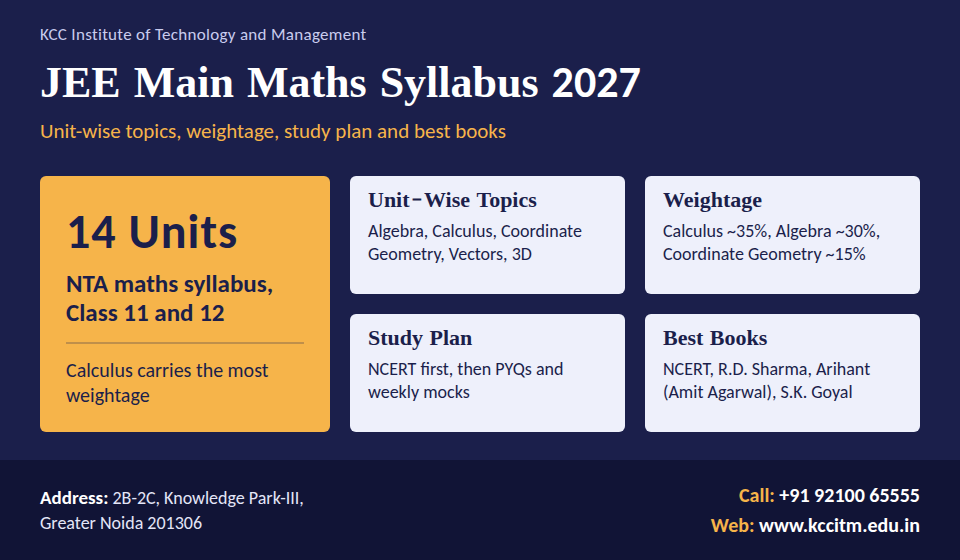
NTA groups Maths into 14 units drawn from the Class 11 and Class 12 NCERT books. To make them easier to study, the units below are organised into six working clusters, each with a short note on how it behaves in the exam.
1. Algebra Cluster
This cluster covers six units and usually supplies the largest number of questions in the paper.
Sets, Relations and Functions You need to be comfortable with how sets are written and combined (union, intersection, complement), the power set, the different kinds of relations (reflexive, symmetric, transitive and equivalence relations) and the classification of functions as one-one, onto or into. Composition of functions is also part of this unit. Exam angle: Questions are usually counting-based, such as the number of relations or onto functions between two small sets.
Complex Numbers and Quadratic Equations The unit starts with complex numbers as ordered pairs and the a + ib form, moves to the Argand plane, modulus and argument, and basic algebra of complex numbers. It then covers quadratic equations over real and complex numbers, the link between roots and coefficients, how to judge the nature of roots, and how to build an equation from given roots. Exam angle: Geometry of complex numbers (locus, rotation, distance) and root-based conditions are favourites.
Matrices and Determinants Topics include the types of matrices, matrix operations, determinants of order two and three, area of a triangle using determinants, adjoint and inverse of a square matrix, and testing the consistency of linear systems in two or three variables. Exam angle: Expect at least two questions. Properties of determinants, adjoint relations and systems with infinite or no solutions come up repeatedly.
Permutations and Combinations The fundamental counting principle, the meaning and use of P(n, r) and C(n, r), and straightforward applications. Exam angle: Arrangement problems with conditions, circular-style restrictions and distribution questions. Probability depends on this chapter, so a weak base here hurts twice.
Binomial Theorem and Its Simple Applications Expansion for a positive integral index, general term, middle term and simple applications. Exam angle: Finding a specific term, a coefficient or a term independent of x. Remainder and divisibility questions also appear.
Sequence and Series Arithmetic and geometric progressions, inserting arithmetic and geometric means between two numbers, and the relationship between A.M. and G.M. Exam angle: Mixed AP-GP problems and sum-based numerical questions.
2. Calculus Cluster
Calculus is the heart of JEE Main Maths. Together, its three units routinely account for roughly a quarter to a third of the paper.
Limits, Continuity and Differentiability The unit covers real-valued functions and their algebra, graphs of standard functions (polynomial, rational, trigonometric, logarithmic, exponential, inverse), limits, continuity and differentiability, and differentiation rules including chain rule, implicit and composite functions. Derivatives up to the second order are included. It also covers applications: rate of change, increasing and decreasing functions, and maxima and minima for one variable. Exam angle: Limit evaluation, checking continuity at a point and optimisation problems are most common.
Integral Calculus Integration as the reverse of differentiation, standard integrals, and techniques such as substitution, integration by parts, partial fractions and trigonometric identities. The unit also includes the fundamental theorem of calculus, properties of definite integrals and area enclosed by simple curves. Exam angle: Definite integral properties (such as symmetry and King’s property) and area questions are high-yield.
Differential Equations Order and degree of an ordinary differential equation, solving by variable separation, and solving homogeneous and linear first-order equations. Exam angle: Usually one question, often a linear or homogeneous equation with a given initial condition.
3. Coordinate Geometry Cluster
Coordinate Geometry (2D) The unit opens with the Cartesian plane basics: distance and section formulae, locus, slope, parallel and perpendicular lines, and intercepts. It then covers straight lines (different equation forms, intersection, angle between lines, concurrency, distance from a point to a line, and triangle centres such as centroid, orthocentre and circumcentre), the circle (standard and general form, diameter form), and the three conic sections: parabola, ellipse and hyperbola in standard form. Exam angle: Conics is the single biggest chapter here. Tangent, normal and focal-chord questions appear in almost every paper.
4. Vectors and 3D Geometry Cluster
Vector Algebra Scalars and vectors, vector addition, components in two and three dimensions, and the scalar (dot) and vector (cross) products. Exam angle: Applications of dot and cross products, plus scalar triple product style questions.
Three-Dimensional Geometry Coordinates in space, distance and section formula, direction ratios and cosines, the angle between lines, equation of a line, skew lines and the shortest distance between them. Exam angle: Shortest distance between skew lines and the angle or intersection between lines in space.
5. Statistics and Probability Cluster
Statistics and Probability Measures of dispersion, mean, median and mode for grouped and ungrouped data, standard deviation, variance and mean deviation. Under probability: the probability of an event, addition and multiplication theorems, Bayes’ theorem and the probability distribution of a random variable. Exam angle: Conditional probability, Bayes’ theorem and binomial-type distributions score very reliably once your P&C is solid.
6. Trigonometry
Trigonometry Trigonometric identities and functions, along with inverse trigonometric functions and their properties. Exam angle: Usually one question, often inside a larger problem. The real value of Trigonometry is that Calculus, Complex Numbers and Coordinate Geometry all lean on it.
Class 11 vs Class 12: Where the Marks Come From
The two classes split the paper almost evenly. Class 11 contributes sets and functions, most of algebra, trigonometry and two-dimensional geometry. Class 12 contributes calculus, 3D geometry, vectors, matrices and probability.
The common mistake is to rush through Class 11 because Class 12 looks “more important”. In practice, Class 11 topics such as Conic Sections, Complex Numbers and Permutations and Combinations are consistently tested, and they are also the foundation for Class 12 chapters. A student who is weak in Class 11 algebra will struggle in Calculus and Probability as well.
JEE Main Maths Chapter Priority 2027 (Indicative)
NTA does not publish official chapter weightage, so the table below is a study guide drawn from patterns in recent papers rather than a guarantee. Question counts shift slightly from session to session.
| Priority | Cluster / Chapters | Typical questions per paper |
|---|---|---|
| Must-win | Calculus (limits, differentiation, applications, integrals, differential equations) | 6 – 8 |
| Must-win | Coordinate Geometry (circles, conics, straight lines) | 3 – 5 |
| Must-win | Matrices and Determinants | 2 – 3 |
| Must-win | Probability and Statistics | 2 – 3 |
| High | Vectors and 3D Geometry | 3 – 4 |
| High | Complex Numbers and Quadratic Equations | 2 |
| High | Sequence and Series, Binomial Theorem | 2 – 3 |
| Medium | Permutations and Combinations, Sets-Relations-Functions, Trigonometry | 2 – 3 combined |
The takeaway is simple: Calculus, Coordinate Geometry and Algebra decide roughly two-thirds of your Maths score. Master those first, then sweep the smaller chapters.
12-Week JEE Main Maths Study Plan for the January Session
This plan assumes you have at least a basic first pass through the syllabus. If you are starting from zero, compress weeks 1 to 8 and give extra time to Calculus and Algebra.
| Weeks | Focus | What to do |
|---|---|---|
| 1 – 2 | Algebra foundation | Complex numbers, quadratics, sequences, binomial theorem. Build a one-page formula sheet. |
| 3 – 4 | Matrices, P&C, Probability | Solve topic-wise previous-year questions after finishing each chapter. |
| 5 – 6 | Differential Calculus | Limits, continuity, differentiability, derivatives and their applications. |
| 7 – 8 | Integral Calculus and Differential Equations | Definite integral properties and area questions daily. |
| 9 | Coordinate Geometry | Circle first, then parabola, ellipse and hyperbola. |
| 10 | Vectors, 3D, Trigonometry | Short, formula-driven chapters, so keep them compact. |
| 11 | Full revision | Re-solve your marked mistakes, not fresh questions. |
| 12 | Mock tests | At least three full-length papers, with a proper analysis after each one. |
Best Books for JEE Main Maths
Start with the NCERT Class 11 and 12 textbooks, because the NTA syllabus is mapped to them. Then add one problem book per chapter group rather than collecting many.
| Book | Best used for |
|---|---|
| NCERT Mathematics (Class 11 and 12) | Concept clarity and the baseline syllabus |
| Skills in Mathematics series (Arihant) | Calculus, algebra and trigonometry practice |
| Cengage Mathematics series | Concept depth plus graded problems |
| Objective Mathematics by R.D. Sharma | Large volume of MCQ-style practice |
| Trigonometry and Coordinate Geometry by S.L. Loney | Advanced trigonometry and conics |
| Algebra by Hall and Knight | Algebra and complex numbers |
| Problems in Mathematics by A. Das Gupta | Mixed-chapter problem solving |
If you can only afford the time for one or two, pick NCERT plus one strong objective series and finish it fully.
Smart Preparation Tips for JEE Main Maths 2027
- Treat Section B seriously. With all five numerical questions compulsory, practise solving without options. Calculation accuracy matters more than speed here.
- Keep a mistake log. Write down each error with its cause (concept gap, calculation slip or misreading). Revisit the log every weekend.
- Learn the standard results. Conic equations, determinant properties and definite integral properties save minutes per question.
- Practise topic-wise PYQs before full mocks. Previous papers show you how the same concept gets repackaged year after year.
- Plan your attempt order. Many students start with easier Algebra and Probability, take Calculus next, and keep lengthy Coordinate Geometry for last. Find the order that suits you through mocks.
- Revise in short loops. A 20-minute formula revision every morning beats one long weekend session.
- Use NTA’s official mock tests. They help you get used to the computer-based interface before exam day.
Common Mistakes Students Make With the JEE Main Maths Syllabus
- Studying deleted topics from outdated material.
- Skipping Class 11 chapters because they feel “easy”.
- Doing only theory or only practice, instead of alternating both.
- Ignoring Vectors, 3D and Trigonometry because each is small. Together they add up to several questions.
- Taking mocks without analysing them. A mock you do not review teaches almost nothing.
Frequently Asked Questions (FAQs)
Q1. What is the JEE Main Maths Syllabus 2027?
It is the list of 14 units from the Class 11 and Class 12 NCERT books that NTA allows in the Mathematics section, ranging from Sets, Relations and Functions to Trigonometry. The unit-wise breakdown is given above.
Q2. Is the JEE Main Maths Syllabus 2027 different from 2026?
No major change has been reported. The rationalised syllabus introduced in 2024 is expected to continue. Verify against the official information bulletin on jeemain.nta.nic.in.
Q3. Which chapters are most important in JEE Main Maths?
Calculus, Coordinate Geometry (especially conic sections and circles), Matrices and Determinants, and Probability are the highest-yield areas, with Algebra chapters close behind.
Q4. How many Maths questions come in JEE Main?
The Maths section has 25 questions: 20 multiple-choice and 5 numerical-value questions, for a total of 100 marks.
Q5. Is NCERT enough for JEE Main Maths?
NCERT is necessary for concept building, but it is not enough for the speed and difficulty level the exam demands. Add a good problem book and previous-year papers.
Q6. Which topics were removed from the JEE Main Maths syllabus?
Mathematical Induction and Mathematical Reasoning were removed in the 2024 rationalisation, along with some smaller sub-topics.
Q7. When does JEE Main 2027 Session 1 registration close?
As per the reported NTA schedule, Session 1 applications close on 22 November 2026. Late-fee windows, if any, are listed in the bulletin.
Q8. How long should I prepare Maths for the January session?
If you start now, plan roughly twelve weeks: eight for chapters, one for revision and the rest for mocks.
Final Words
The JEE Main Maths Syllabus is smaller than it looks once you group it into clusters. Calculus, Coordinate Geometry and Algebra carry most of the marks, and the rest of the units reward steady, consistent revision. Download the official syllabus from the NTA portal, follow a time-bound plan, practise previous-year questions chapter by chapter, and review every mock honestly. Do that for twelve weeks and the 100 marks in Maths become very reachable.
Disclaimer: Dates and syllabus details are based on reports of NTA’s public notice dated 24 October 2026. Please confirm them on the official website before publishing or acting on them.
Also Read:
JEE Main Maths Syllabus 2027: Unit-Wise Topics, Weightage, Study Plan & Best Books
JEE Main 2027 Registration (Live): Session 1 Form Dates, Last Date, Fees, Documents and Direct Link
JEE Main 2027 Exam Fees: Category-Wise Registration Fee for General, OBC, EWS, SC/ST
JEE Main Admit Card 2027: Check Dates, How to Download?
JEE Main 2027 Registration Documents Required: Complete Checklist, OBC Documents, File Sizes & Fees
JEE Main Application Form 2027: Registration Process, Login, Fees and Documents