
JEE Main Chemistry Syllabus 2027: Quick Overview
If you are preparing for the engineering entrance season of 2027, the first document you should understand is the JEE Main Chemistry syllabus. Chemistry is the one subject in the paper where a well-organised student can pick up marks quickly, because many questions test a clear fact, a trend or a standard reaction rather than a long derivation. But you can only prepare smartly when you know exactly which chapters are in and which are out.
This guide walks through the JEE Main Chemistry syllabus 2027 in plain language: all 20 chapters grouped into Physical, Inorganic and Organic Chemistry, the topics that NTA has removed, how to get the JEE Mains syllabus 2027 PDF download NTA releases, and a practical plan to finish the portion on time.
| Detail | Information |
|---|---|
| Exam | JEE Main 2027 (Paper 1, B.E./B.Tech) |
| Conducting body | National Testing Agency (NTA) |
| Subject | Chemistry |
| Syllabus based on | NCERT Class 11 and Class 12 |
| Total chapters | 20 (8 Physical, 4 Inorganic, 8 Organic) |
| Questions per subject | 25 (20 multiple-choice + 5 numerical value) |
| Marks per question | 4 |
| Official website | jeemain.nta.nic.in |
Has NTA Released the JEE Main Syllabus 2027?
At the time of writing (October 2026), NTA has not published a separate, standalone JEE syllabus 2027 document. The syllabus normally appears together with the information bulletin on the official website, jeemain.nta.nic.in, once the new exam cycle opens. Until then, the practical approach followed by most teachers is to prepare from the latest rationalised syllabus used for the 2025 and 2026 attempts, because NTA has not signalled any fresh cuts.
That means everything below is the syllabus you should be studying right now. We will update the list the day the official 2027 notification goes live. Whenever a conflict appears between this page and the NTA document, the NTA document wins.
How to Download the JEE Main Chemistry Syllabus PDF 2027 from NTA
When the notification is out, you can save the official JEE Main Chemistry syllabus PDF 2027 in a few steps:
- Open the NTA JEE Main portal at jeemain.nta.nic.in.
- Look for the “Syllabus” or “Information Bulletin” link on the home page or under the latest updates.
- Choose the Paper 1 syllabus for B.E./B.Tech. The file contains Mathematics, Physics and Chemistry together.
- Download the PDF and save it on your phone and laptop. Print the Chemistry pages and keep them on your study table.
Pro tip: use the PDF as a checklist. Tick each sub-topic only after you have solved questions on it, not just after reading it.
JEE Main Chemistry Syllabus 2027: Section-Wise Breakup
The JEE Main Chemistry syllabus is split into three branches. Each branch needs a different style of preparation.
| Branch | Chapters | What it rewards |
|---|---|---|
| Physical Chemistry | 8 | Concept clarity plus calculation speed |
| Inorganic Chemistry | 4 | Memory, trends and NCERT line-by-line reading |
| Organic Chemistry | 8 | Mechanisms, reagents and reaction logic |
Physical Chemistry Syllabus for JEE Main 2027
Physical Chemistry connects theory with numbers. Expect formula-based questions, so practise units and unit conversions along with the concepts.
1. Some Basic Concepts in Chemistry
The starting point of numerical chemistry: nature of matter, the atomic theory, how atoms and molecules are counted through the mole concept, molar mass, percentage composition, empirical and molecular formulae, and balancing equations to solve stoichiometry problems.
2. Atomic Structure
Light as electromagnetic radiation, the photoelectric effect, the hydrogen spectrum and the Bohr model (including its postulates, energy and radius expressions, and drawbacks). It then moves to wave-particle duality, de Broglie wavelength, the uncertainty principle, the quantum-mechanical model, orbitals and their shapes, the four quantum numbers, and the rules used to fill electrons: Aufbau, Pauli and Hund, along with the extra stability of half-filled and fully filled sets.
3. Chemical Bonding and Molecular Structure
The Kossel-Lewis idea of bond formation, ionic bonding and lattice enthalpy, covalent character through electronegativity, Fajans’ rules and dipole moment, shapes of molecules using VSEPR, valence bond theory with hybridisation (including d-orbital involvement) and resonance, molecular orbital theory for homonuclear diatomic molecules with bond order, bond length and bond energy, and a basic look at metallic and hydrogen bonding.
4. Chemical Thermodynamics
Systems, surroundings, state functions, intensive and extensive properties, the first law with work, heat, internal energy and enthalpy, heat capacities, Hess’s law, the many named enthalpies (formation, combustion, atomisation, solution and more), and the second law with entropy and Gibbs energy as the test for spontaneity, linked to the equilibrium constant.
5. Solutions
Ways of expressing concentration (molarity, molality, mole fraction, percentages), vapour pressure and Raoult’s law for ideal and non-ideal solutions, colligative properties of dilute solutions (lowering of vapour pressure, freezing-point depression, boiling-point elevation, osmotic pressure), finding molar mass from them, and the van’t Hoff factor for abnormal results.
6. Equilibrium
Dynamic equilibrium in physical processes (including Henry’s law) and in chemical reactions, Kc and Kp, the role of Gibbs energy, factors that shift equilibrium and Le Chatelier’s principle. The ionic part is the heaviest: strong and weak electrolytes, acid-base theories (Arrhenius, Brønsted-Lowry, Lewis), ionisation constants, pH, common-ion effect, salt hydrolysis, solubility product and buffer solutions.
7. Redox Reactions and Electrochemistry
Oxidation numbers and balancing redox equations, conductance in electrolytes, molar conductivity and Kohlrausch’s law, galvanic and electrolytic cells, electrode potentials, cell EMF, the Nernst equation, its link with Gibbs energy, and practical cells such as the dry cell, lead accumulator and fuel cells.
8. Chemical Kinetics
Rate of reaction and the factors that change it, order and molecularity, rate law and rate constant, zero-order and first-order integrated equations with half-life, the effect of temperature through the Arrhenius equation and activation energy, and the basic collision theory for bimolecular gas reactions (no derivation needed).
Inorganic Chemistry Syllabus for JEE Main 2027
Inorganic Chemistry has only four chapters in the current syllabus, which makes it the most compact scoring block. Most questions can be answered if you have read the NCERT text carefully.
9. Classification of Elements and Periodicity in Properties
The modern periodic law, the s, p, d and f block layout, and periodic trends: atomic and ionic radii, ionisation enthalpy, electron gain enthalpy, valence, oxidation states and chemical reactivity.
10. p-Block Elements
Groups 13 to 18: electronic configurations, how properties change across a period and down a group, and the unusual behaviour of the first member of each group.
11. d- and f-Block Elements
First-row transition metals: configuration, occurrence, trends in radii, ionisation enthalpy, oxidation states, colour, catalytic behaviour, magnetism, complex formation, interstitial compounds and alloys, plus the preparation, properties and uses of potassium dichromate and potassium permanganate. For the inner transition series: configuration and oxidation states of lanthanoids and actinoids, and lanthanoid contraction.
12. Coordination Compounds
Werner’s theory, ligands, coordination number, denticity and chelation, IUPAC naming of mononuclear complexes, isomerism, bonding through valence bond ideas and basic crystal field theory, colour and magnetic behaviour, and the importance of complexes in analysis, metal extraction and biology.
Organic Chemistry Syllabus for JEE Main 2027
Organic Chemistry rewards logic. Learn why a reaction happens and the product stops feeling like something to memorise.
13. Purification and Characterisation of Organic Compounds
Separation methods (crystallisation, sublimation, distillation, differential extraction, chromatography), detecting nitrogen, sulphur, phosphorus and halogens, the basic principles of estimating elements, and numerical problems for empirical and molecular formulae.
14. Some Basic Principles of Organic Chemistry
The foundation chapter: tetravalency and hybridisation of carbon, functional groups, homologous series, structural and stereoisomerism, trivial and IUPAC naming, bond fission, free radicals, carbocations, carbanions, electrophiles and nucleophiles, electronic effects (inductive, electromeric, resonance, hyperconjugation) and the main reaction types: substitution, addition, elimination and rearrangement.
15. Hydrocarbons
Alkanes (conformations of ethane and halogenation mechanism), alkenes (geometrical isomerism, electrophilic addition, Markovnikov’s rule and the peroxide effect, ozonolysis, polymerisation), alkynes (acidic nature and addition reactions) and aromatic hydrocarbons (benzene structure, aromaticity, electrophilic substitution, Friedel-Crafts reactions and directing effects).
16. Organic Compounds Containing Halogens
Preparation, properties and reactions of haloalkanes and haloarenes, the nature of the C-X bond, substitution mechanisms, and the environmental impact of chloroform, iodoform, freons and DDT.
17. Organic Compounds Containing Oxygen
The largest organic chapter. It includes alcohols (classification tests and dehydration mechanism), phenols (acidity, electrophilic substitution, Reimer-Tiemann), ether structure, aldehydes and ketones (nucleophilic addition, Grignard reagent, Wolff-Kishner and Clemmensen reductions, aldol, Cannizzaro, haloform and distinguishing tests) and carboxylic acids with the factors controlling their acid strength.
18. Organic Compounds Containing Nitrogen
Amines (naming, classification, structure, basic strength, distinguishing primary, secondary and tertiary types) and diazonium salts, with their importance in synthesis.
19. Biomolecules
Carbohydrates (glucose, fructose, sucrose, lactose, maltose), amino acids, peptide bond and the four levels of protein structure, denaturation, enzymes, vitamins, nucleic acids (DNA and RNA) and an introduction to hormones.
20. Principles Related to Practical Chemistry
The chemistry behind lab work: detecting extra elements and functional groups in organic compounds, preparing Mohr’s salt, potash alum, acetanilide, p-nitroacetanilide, aniline yellow and iodoform, titrations (acid-base, oxalic acid and Mohr’s salt against KMnO4), qualitative salt analysis for a listed set of cations and anions, and simple experiments such as enthalpy of solution and neutralisation, preparing lyophilic and lyophobic sols, and the iodide-hydrogen peroxide kinetics study.
Topics Removed from the JEE Main Chemistry Syllabus
Since the rationalisation, a good part of the older Chemistry portion no longer appears. Do not waste time on these unless you also plan to write other exams that need them.
| Removed area | What dropped out |
|---|---|
| States of Matter (gaseous, liquid and solid states) | Gas laws, kinetic theory, real gases, liquid properties, crystal lattices, unit cells, packing and defects |
| Basic concepts (measurement part) | SI units, dimensional analysis, precision, accuracy and significant figures |
| Atomic Structure | Thomson and Rutherford models |
| Surface Chemistry | Adsorption, catalysis, colloids, emulsions |
| Metallurgy | General principles and processes of isolating metals |
| Hydrogen | Position, isotopes, water, hydrogen peroxide, hydrides |
| s-Block Elements | Entire chapter |
| p-Block (compound-level detail) | Group-wise preparation, structures and uses of specific compounds |
| Environmental Chemistry | Pollution types, ozone depletion, greenhouse effect |
| Polymers | Classification, polymerisation, rubber, common polymers |
| Chemistry in Everyday Life | Drugs, food chemicals, soaps and detergents |
A word of caution: some websites still show older, longer lists. Always match what you study with the latest NTA document.
How the 25 Chemistry Questions Are Typically Structured
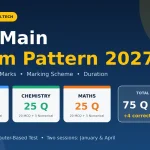
In the recent pattern, each subject carries 25 questions: 20 multiple-choice questions and 5 numerical-value questions, each worth 4 marks. Always check the information bulletin for the final rules on attempting limits and negative marking before the exam, because NTA can change them between cycles.
A useful way to read the paper: the Physical section produces most of the numerical questions, Organic produces concept and mechanism questions, and Inorganic produces direct recall and trend questions. A student who is strong in all three can finish Chemistry faster than Physics or Maths and use the extra minutes elsewhere.
Which Chapters Deserve the Most Attention?
No official chapter-wise weightage is published by NTA, so treat any table of “exact” weightage with caution. What previous papers consistently show is that some chapters are asked almost every session. A sensible priority list looks like this:
- Priority 1 (revise repeatedly): Mole concept and stoichiometry, Chemical Bonding, Thermodynamics, Equilibrium (especially ionic), Electrochemistry, Coordination Compounds, p-Block, Aldehydes-Ketones-Carboxylic Acids, General Organic Chemistry.
- Priority 2 (solid coverage): Atomic Structure, Solutions, Chemical Kinetics, d- and f-Block, Hydrocarbons, Amines, Halogen compounds.
- Priority 3 (finish once, revise lightly): Periodic Classification, Purification of Organic Compounds, Biomolecules, Practical Chemistry.
Priority 3 chapters are short and quite often hand out easy marks, so do not skip them.
Smart Preparation Strategy for the Chemistry Syllabus
Treat NCERT as your base text
The syllabus is built on the Class 11 and 12 NCERT books. Read the Inorganic chapters line by line, including examples, exceptions and the tables. Many direct questions are framed from those very lines.
Divide your time across the three branches
A balanced split works for most students: roughly 40 percent of your Chemistry time on Physical (practice-heavy), 30 percent on Organic (mechanism practice) and 30 percent on Inorganic (reading and revision cycles).
Build a short formula and reaction notebook
Keep one page per chapter. For Physical, write formulas with their units. For Organic, write named reactions with reagent, condition and product. For Inorganic, write trends and exceptions. This notebook becomes your last-week revision tool.
Practise in timed sets
Solve 25-question sets within a fixed time, and review mistakes by category: concept gap, silly error or time pressure. Previous-year papers of the last several sessions are the best way to understand how the syllabus is turned into actual questions.
Revise on a schedule, not on a mood
Use a simple cycle: revise a chapter after one day, one week and one month. For Inorganic facts, a quick daily 20-minute recall session works better than long weekend marathons.
Common Mistakes Students Make with the Chemistry Syllabus
- Studying deleted chapters because an older website or book still lists them.
- Relying on summaries and never opening NCERT.
- Memorising reactions without understanding the mechanism, which fails when the question is slightly twisted.
- Ignoring practical chemistry principles, salt analysis and titration chemistry.
- Postponing numericals until the last month, when speed cannot be built overnight.
Final Thoughts
The JEE Main Chemistry syllabus 2027 is short, clearly defined and anchored in NCERT, which is exactly why it can become your strongest subject. Save the official PDF the moment NTA publishes it, compare it with the chapter list above, and let the checklist guide your daily plan. Consistent small sessions across Physical, Organic and Inorganic will do more for your score than occasional long study days.
Frequently Asked Questions (FAQs)
Q1. Is the JEE Main Chemistry syllabus 2027 released?
Not yet as a separate document at the time of writing. NTA normally publishes it with the information bulletin on jeemain.nta.nic.in. Until then, follow the latest rationalised syllabus.
Q2. Where can I get the JEE Main Chemistry syllabus PDF 2027?
The official PDF will be available on the NTA website once released. Look under the syllabus or information bulletin section for Paper 1.
Q3. How many chapters are in the JEE Main Chemistry syllabus?
The current syllabus has 20 chapters: 8 in Physical, 4 in Inorganic and 8 in Organic Chemistry.
Q4. Is NCERT enough for the JEE Main Chemistry syllabus?
NCERT is the essential base and covers most of Inorganic and a large part of Organic. For Physical Chemistry, add problem-solving practice from a good question bank and previous-year papers.
Q5. Which topics have been removed from JEE Main Chemistry?
States of Matter (including the solid state), Surface Chemistry, Metallurgy, Hydrogen, s-Block, Environmental Chemistry, Polymers and Chemistry in Everyday Life, along with some detailed p-block compound topics.
Q6. Which branch of Chemistry is the easiest to score in?
Most students find Inorganic the quickest to score because it is fact-based and NCERT-driven, while Organic is the one that needs the most practice.
Q7. Is the JEE Main Chemistry syllabus the same as the CBSE syllabus?
It is built on the same NCERT Class 11 and 12 books, but the JEE document trims some portions and emphasises application. Always follow the NTA list for JEE preparation.
Q8. How many questions come from Chemistry in JEE Main?
There are 25 questions in the Chemistry section, normally 20 multiple-choice and 5 numerical-value questions, 4 marks each.
Q9. How many hours a day should I give to Chemistry?
A steady 2 to 3 hours a day in the early phase, shifting to more revision and practice closer to the exam, is a reasonable guide.
Q10. Can I skip any chapter in the syllabus?
It is better not to. Even low-weightage chapters occasionally give direct, easy questions.
Disclaimer: Syllabus details are based on the latest NTA syllabus available to us. Please confirm the final list on the official NTA website before finalising your preparation plan.