
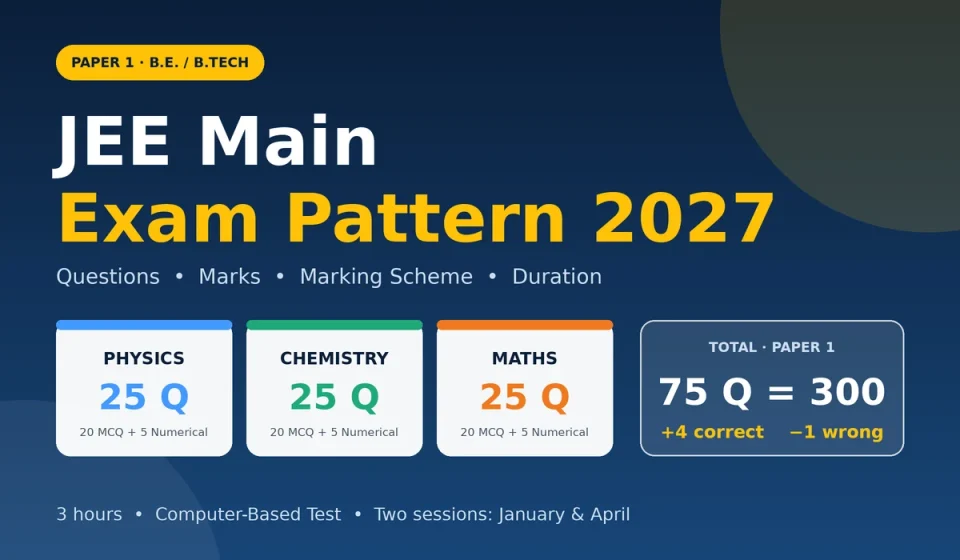

Quick answer: The JEE Main exam pattern for Paper 1 (B.E./B.Tech) has 75 compulsory questions for 300 marks: 25 each from Physics, Chemistry and Mathematics, split into 20 MCQs and 5 numerical value questions per subject. The test is computer-based, runs for 3 hours, and gives +4 for a correct answer and -1 for a wrong one. NTA has not yet released the 2027 information bulletin, so this is the 2026 format, which has stayed unchanged since 2025.
Before you solve a single chapter-wise question, you should know exactly what the paper looks like. The JEE Main exam pattern tells you how many questions you will face, how marks are added and deducted, and how to split 180 minutes across three subjects. A student who knows the pattern attempts the paper with a plan. A student who does not, usually runs out of time on the numericals.
NTA’s exam calendar lists JEE Main 2027 Session 1 for January 22 to 24 and 28 to 30, 2027, with January 31 kept as a buffer date, and Session 2 is expected in April 2027. The official 2027 bulletin is expected in the last week of October 2026 on jeemain.nta.nic.in. This guide covers the JEE Main paper pattern for all three papers, the marking scheme, the negative marking rule, time-management numbers and exam-day details, and we will update it the day the bulletin goes live. For the full JEE Main 2027 series, visit our JEE Main hub.
In this article
- JEE Main Exam Pattern 2027: Quick Overview
- Has the JEE Main Exam Pattern Changed for 2027?
- JEE Main Paper 1 Exam Pattern (B.E./B.Tech)
- JEE Main Marking Scheme and Negative Marking
- JEE Main Paper 2A and 2B Exam Pattern (B.Arch and B.Planning)
- JEE Main Exam Duration, Mode, Shifts and Languages
- How the Exam Pattern Affects Your Score and Percentile
- How to Prepare as Per the JEE Main Exam Pattern
- Conclusion
- Related Blogs
- FAQs on JEE Main Exam Pattern
JEE Main Exam Pattern 2027: Quick Overview
NTA conducts JEE Main as three separate papers. Paper 1 is for B.E./B.Tech, Paper 2A is for B.Arch and Paper 2B is for B.Planning. Here is the JEE Main paper pattern side by side.
| Particulars | Paper 1 (B.E./B.Tech) | Paper 2A (B.Arch) | Paper 2B (B.Planning) |
|---|---|---|---|
| Conducting body | National Testing Agency (NTA) | NTA | NTA |
| Exam mode | Computer-based test (CBT) | CBT for Mathematics and Aptitude; Drawing on paper with pen | CBT |
| Duration | 3 hours (4 hours for PwD candidates) | 3 hours | 3 hours |
| Subjects | Physics, Chemistry, Mathematics | Mathematics, Aptitude Test, Drawing Test | Mathematics, Aptitude Test, Planning |
| Total questions | 75 | 77 | 100 |
| Total marks | 300 | 400 | 400 |
| Question types | MCQs and numerical value questions | MCQs, numerical value questions and 2 drawing tasks | MCQs and numerical value questions |
| Marking scheme | +4 correct, -1 wrong | +4 correct, -1 wrong (no negative marking in Drawing) | +4 correct, -1 wrong |
| Sessions | January and April | January and April | January and April |
Pro tip: Most candidates only need the Paper 1 column. Read the Paper 2A and 2B sections only if you are applying for architecture or planning.
Has the JEE Main Exam Pattern Changed for 2027?
As of October 14, 2026, NTA has not published the JEE Main 2027 information bulletin, so no official 2027 pattern exists yet. Coaching and education portals expect the same structure as 2026, and the 2026 structure itself matched 2025. The big change came when NTA trimmed Section B and made every numerical question compulsory. The table below shows what that did.
| Feature (Paper 1) | 2024 and earlier | 2026 format (expected for 2027) |
|---|---|---|
| Questions per subject | 30 (20 MCQs + 10 numericals) | 25 (20 MCQs + 5 numericals) |
| Numerical questions to attempt | Any 5 out of 10 in each subject | All 5 in each subject |
| Questions on the paper | 90, of which 75 were attempted | 75, all compulsory |
| Negative marking for wrong numericals | No | Yes, -1 |
Older blogs still show “90 questions, attempt 75”. That is the pre-2025 format. If you see it, you are reading outdated information.
Try this: Bookmark jeemain.nta.nic.in and compare this page with the information bulletin the day it is released. We will flag any difference at the top of this article.
JEE Main Paper 1 Exam Pattern (B.E./B.Tech)
Paper 1 decides your B.Tech rank. It has three sections, one per subject, and each subject is divided into Section A (MCQs) and Section B (numerical value questions). Every question is compulsory.
Subject-Wise Question Distribution
| Subject | Section A (MCQs) | Section B (Numerical) | Total questions | Total marks |
|---|---|---|---|---|
| Physics | 20 | 5 | 25 | 100 |
| Chemistry | 20 | 5 | 25 | 100 |
| Mathematics | 20 | 5 | 25 | 100 |
| Total | 60 | 15 | 75 | 300 |
Every subject carries equal weight, so a weak Chemistry paper cannot be rescued by a strong Mathematics paper beyond the marks that subject offers. For a deeper subject-wise count, read how many questions are there in JEE Main.
Section A vs Section B
- Section A (MCQs): Four options, one correct answer. You select an option on screen.
- Section B (numerical value): No options. You type the answer using the on-screen keypad, following the rounding instruction given in the question.
Section B is where careless mistakes hurt most. A correct method with a wrong decimal or sign scores the same as a wrong answer, and under the current scheme it also costs you a mark.
Quick tip: Syllabus coverage now matters more than selective skipping. Because all numericals are compulsory, check the JEE Main syllabus 2027 and the list of deleted chapters before you finalise your study plan.
JEE Main Marking Scheme and Negative Marking
The JEE Main marking scheme is the same across all papers, apart from the Drawing test in Paper 2A.
| Situation | Marks |
|---|---|
| Correct MCQ | +4 |
| Wrong MCQ | -1 |
| Correct numerical value answer | +4 |
| Wrong numerical value answer | -1 |
| Unattempted or only marked for review | 0 |
| Drawing test (Paper 2A) | Evaluated out of 100, no negative marking |
Is There Negative Marking for Numerical Questions?
Yes, under the current format. Wrong answers in Section B lose 1 mark, just like wrong MCQs. This is a change from earlier years, when numericals carried no penalty, and it is why some older articles and coaching pages still say “no negative marking in Section B”. Always confirm the rule in the 2027 bulletin and on the instruction screen before your exam starts.
What Your Score Looks Like: Three Examples
These examples assume -1 applies to every wrong answer, MCQ or numerical.
| Attempt style | Correct | Wrong | Unattempted | Score (out of 300) |
|---|---|---|---|---|
| Aggressive | 60 | 10 | 5 | 230 |
| Balanced | 45 | 15 | 15 | 165 |
| Cautious | 30 | 5 | 40 | 115 |
Look at the first row. Ten wrong answers cost only 10 marks, while 60 correct answers add 240. Negative marking is a small penalty. Accuracy matters, but fear of -1 should not stop you from attempting questions you can solve.
Should You Guess in JEE Main?
With four options, a pure random guess on an MCQ has an expected value of +0.25 marks (a 25% chance of +4 and a 75% chance of -1). Eliminate one option and the expected value rises to about +0.67. Eliminate two and it reaches +1.5. So an informed guess helps, and a blind guess is roughly break-even with high variance. For numericals there are no options to eliminate, so guessing without working rarely pays.
Smart move: In mock tests, track how many marks you lose to wrong attempts versus unattempted questions. That single number tells you whether to attempt more or attempt cleaner.
JEE Main Paper 2A and 2B Exam Pattern (B.Arch and B.Planning)
Paper 2A: B.Arch Exam Pattern
Paper 2A is the only JEE Main paper with a pen-and-paper component. Mathematics and Aptitude are computer-based, and the Drawing test is done on paper.
| Part | Questions | Type | Marks |
|---|---|---|---|
| Mathematics | 25 (20 MCQs + 5 numericals) | Objective and numerical | 100 |
| Aptitude Test | 50 | MCQs | 200 |
| Drawing Test | 2 tasks (50 marks each) | Pen and paper | 100 |
| Total | 77 | 400 |
Paper 2B: B.Planning Exam Pattern
| Part | Questions | Type | Marks |
|---|---|---|---|
| Mathematics | 25 (20 MCQs + 5 numericals) | Objective and numerical | 100 |
| Aptitude Test | 50 | MCQs | 200 |
| Planning-based questions | 25 | MCQs | 100 |
| Total | 100 | 400 |
Candidates who apply for both Paper 2A and Paper 2B get 3.5 hours in total for the combined attempt.
Next step: If you plan to take Paper 2A, practise the Drawing test on A4 sheets with a timer. It is assessed by evaluators, so neatness and proportion count as much as the idea.
JEE Main Exam Duration, Mode, Shifts and Languages
| Detail | Information |
|---|---|
| Duration of Paper 1 | 3 hours (180 minutes); 4 hours for PwD candidates |
| Both Paper 2A and 2B | 3.5 hours combined |
| Mode | Computer-based test; Drawing in Paper 2A on paper |
| Shifts | Usually two per day: 9 AM to 12 PM and 3 PM to 6 PM |
| Sessions | Session 1 in January, Session 2 in April |
| Languages | 13: English, Hindi, Assamese, Bengali, Gujarati, Kannada, Malayalam, Marathi, Odia, Punjabi, Tamil, Telugu, Urdu |
| Calculator | Not provided on screen in the 2026 cycle |
| Rough work | Rough sheets are given at the centre and collected after the test |
You choose the exam language at the time of registration and cannot change it afterwards. If you have not filled the form yet, our guide to the JEE Main application form 2027 walks through each step, and the JEE Main eligibility criteria page confirms who can apply.
Do this: Practise on a computer-based mock test at least once a week from now on. Reading a screen for three hours, using the question palette and typing numerical answers are skills of their own.
How the Exam Pattern Affects Your Score and Percentile
JEE Main runs across several days and shifts, and each shift has a different question paper. Some papers turn out easier and some harder, so NTA does not rank you by raw marks alone. It converts your marks into a percentile-based NTA score within your shift. If you take both sessions, the better score is used for your rank.
That means two things for you. First, a “tough” paper is not a disaster, because normalisation adjusts for difficulty. Second, accuracy under pressure matters more than chasing the maximum, because you are compared with others who sat the same paper. Our JEE Main 2027 exam date page tracks the schedule if you are deciding between one session and two.
How to Prepare as Per the JEE Main Exam Pattern
The pattern gives you three practical rules: all questions are compulsory, wrong answers cost marks, and there is no calculator. Build your preparation around them.
- Cover the full syllabus. With 15 compulsory numericals, no chapter can be ignored completely.
- Practise calculation speed. With no calculator, comfort with squares, cubes, fractions and approximations saves minutes in every subject.
- Train for numericals separately. Solve Section B-style questions without options, so you get used to checking your own answer.
- Attempt full CBT mocks. Sit three-hour tests with 75 questions and review each one for time lost, not only for marks lost.
- Follow a structured plan. Our self-study guide for JEE Main shows how to turn the pattern into a weekly timetable.
A Starting Time Plan for the 180-Minute Paper
Use this as a template and adjust it using your mock test results.
| Step | Time | Goal |
|---|---|---|
| Read instructions and scan the paper | 5 minutes | Confirm marking rules and question palette |
| Section A (60 MCQs) across all three subjects | About 80 minutes | Secure the quick, high-confidence marks first |
| Section B (15 numericals) | About 50 minutes | Solve carefully and recheck each typed entry |
| Review marked questions | About 45 minutes | Revisit doubtful questions and fix silly mistakes |
Pro tip: Start with the subject you are strongest in. An early run of correct answers builds confidence and leaves more time for the harder subject later.
Conclusion
The JEE Main exam pattern is simple once you break it down: 75 compulsory questions, 25 per subject, 300 marks, 3 hours, and +4/-1 marking, with Paper 2A and 2B following their own 400-mark structures. The biggest shift in recent years is that Section B is now five compulsory numericals per subject with negative marking, which rewards complete syllabus coverage and calm accuracy. Treat the numbers on this page as the working JEE Main exam pattern 2027 until NTA publishes the official bulletin, then verify them on jeemain.nta.nic.in and plan your mocks around the same format. You can read the official notices on the NTA JEE Main website.
Related Blogs
FAQs on JEE Main Exam Pattern
Q1. What is the JEE Main exam pattern 2027?
NTA has not released the 2027 bulletin yet. The expected pattern is the same as 2026: Paper 1 has 75 compulsory questions for 300 marks, with 25 questions each from Physics, Chemistry and Mathematics (20 MCQs and 5 numericals per subject), a 3-hour computer-based test and +4/-1 marking.
Q2. How many questions are there in JEE Main Paper 1?
There are 75 questions: 60 MCQs and 15 numerical value questions. Each subject contributes 25 questions and 100 marks.
Q3. What is the total marks of JEE Main?
Paper 1 (B.E./B.Tech) is out of 300 marks. Paper 2A (B.Arch) and Paper 2B (B.Planning) are each out of 400 marks.
Q4. Is there negative marking in JEE Main?
Yes. Each wrong answer costs 1 mark, and under the current format this applies to both MCQs and numerical value questions. Unattempted questions score zero. The Drawing test in Paper 2A has no negative marking. Confirm the rule in the official bulletin each year.
Q5. Are all questions compulsory in JEE Main?
Yes. Since 2025, every question in Paper 1 is compulsory, including all 5 numericals in each subject. The earlier choice of attempting any 5 out of 10 numericals has been removed.
Q6. What is the duration of the JEE Main exam?
Paper 1 and Paper 2A each run for 3 hours. PwD candidates get 4 hours for Paper 1, and candidates who take Paper 2A and 2B together get 3.5 hours in total.
Q7. Has the JEE Main exam pattern changed for 2027?
No change has been announced. The last major change was in 2025, when Section B was reduced to 5 compulsory numerical questions per subject. Check the NTA bulletin when it is released.
Q8. Is JEE Main online or offline?
JEE Main is a computer-based test. The only paper-based part is the Drawing test in Paper 2A (B.Arch).
Q9. When will NTA release the official JEE Main 2027 pattern?
The information bulletin is expected in the last week of October 2026 on jeemain.nta.nic.in, based on the release dates of the last two years. Session 1 is scheduled from January 22, 2027.
Q10. How many times is JEE Main conducted in a year?
Twice: Session 1 in January and Session 2 in April. If you appear in both, the better score is used for your rank.